
Ridgewood Queens property management is becoming increasingly important for condo boards trying to control operating costs while navigating complex NYC regulations. If you’re serving on a condo board in Ridgewood, Queens, you’ve probably had this conversation: “Do we really need to hire a property management company, or can we manage the building ourselves and save money?”
If you’re serving on a condo board in Ridgewood, Queens, you’ve probably had this conversation: “Do we really need to hire a property management company? Can’t we just handle this ourselves and save the money?”
It’s a fair question. Management fees can look like just another line item on an already tight budget. But here’s what most board members discover after a year or two of self-management: the actual costs of going it alone: hidden vendor markups, compliance penalties, accounting errors, and burnout: often exceed what professional property management in Ridgewood Queens would have cost in the first place.
Let’s break down exactly how professional Queens condo management services pay for themselves, and why more Ridgewood boards are making the switch in 2026.
One of the most immediate ways professional management saves money is through vendor relationships. When your 20-unit condo building needs a new boiler or roof repairs, you’re essentially a small fish negotiating with contractors who prioritize their larger clients.
Property management companies flip that dynamic entirely.
A firm managing 50+ buildings across Queens has serious negotiating leverage. They’re bringing plumbers, electricians, roofers, and HVAC specialists consistent volume work throughout the year. That translates to:

Here’s a real-world example: A 30-unit Ridgewood condo needed facade work estimated at $85,000 from a contractor they found independently. When they brought in professional management, the same scope of work through the management company’s network came in at $68,000: a $17,000 difference that more than covered two years of management fees.
This combined buying power extends beyond major projects:
The savings compound quickly when you’re no longer paying retail rates across every service your building requires.
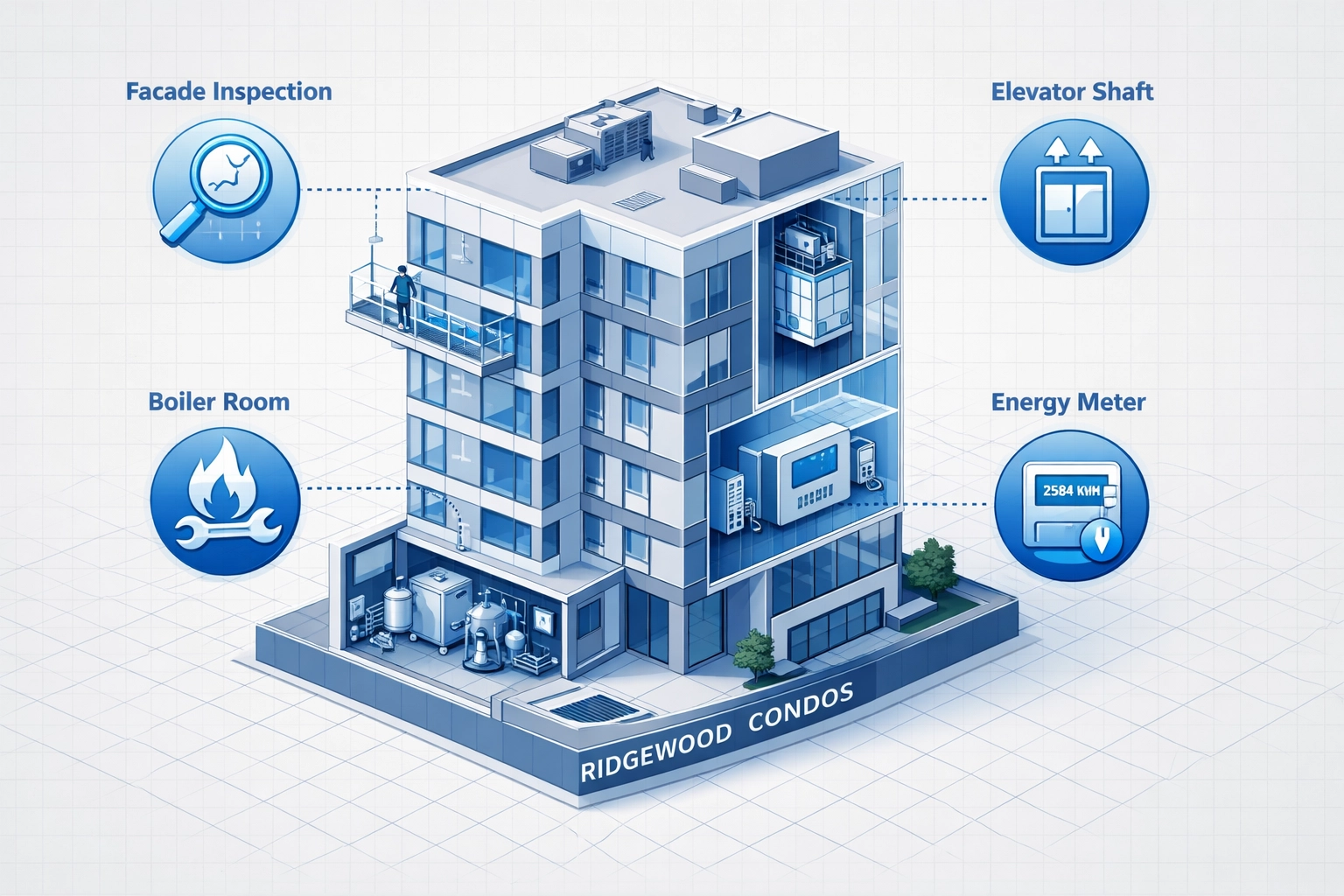
NYC’s regulatory environment for residential buildings gets more complex every year. For volunteer board members juggling full-time jobs, keeping track of deadlines for Local Law 11 (facade inspections), Local Law 87 (energy audits), and elevator certifications is a recipe for missed deadlines and costly violations.
The price of non-compliance isn’t theoretical. Buildings that miss Local Law 11 filing deadlines face penalties starting at $1,000 per month and escalating from there. Local Law 97 fines begin in 2026 for buildings that exceed carbon emission caps, with penalties reaching $268 per ton of excess emissions.
Professional management companies maintain compliance calendars tracking every required filing, inspection, and certification for your building. They coordinate:
Beyond avoiding fines, staying compliant protects your building’s value. Prospective buyers’ attorneys review a building’s violation history during due diligence. A clean DOB record signals well-managed property: open violations raise red flags that can derail sales or reduce unit values.
The cost of professional management suddenly looks different when you frame it as insurance against five-figure penalties and property devaluation.
Here’s where many self-managed condos run into trouble: financial record-keeping. What starts as a simple spreadsheet maintained by a volunteer treasurer quickly becomes an accounting mess when that person moves, gets overwhelmed, or simply doesn’t have the expertise to properly categorize expenses and maintain audit trails.
The consequences can be expensive:
Professional property management in Ridgewood Queens provides systematic financial administration:

Critically, reputable management companies operate with no hidden fees. They don’t mark up vendor invoices or take kickbacks from contractors: a practice that can cost buildings thousands annually. Instead, their fees are straightforward: a fixed percentage of collected revenue or a flat monthly rate, with all pass-through expenses clearly documented.
This transparency extends to record-keeping. With professional management, any board member can access detailed financial reports 24/7 through online portals, eliminating the “black box” problem that often develops with self-management when only one or two people control the books.
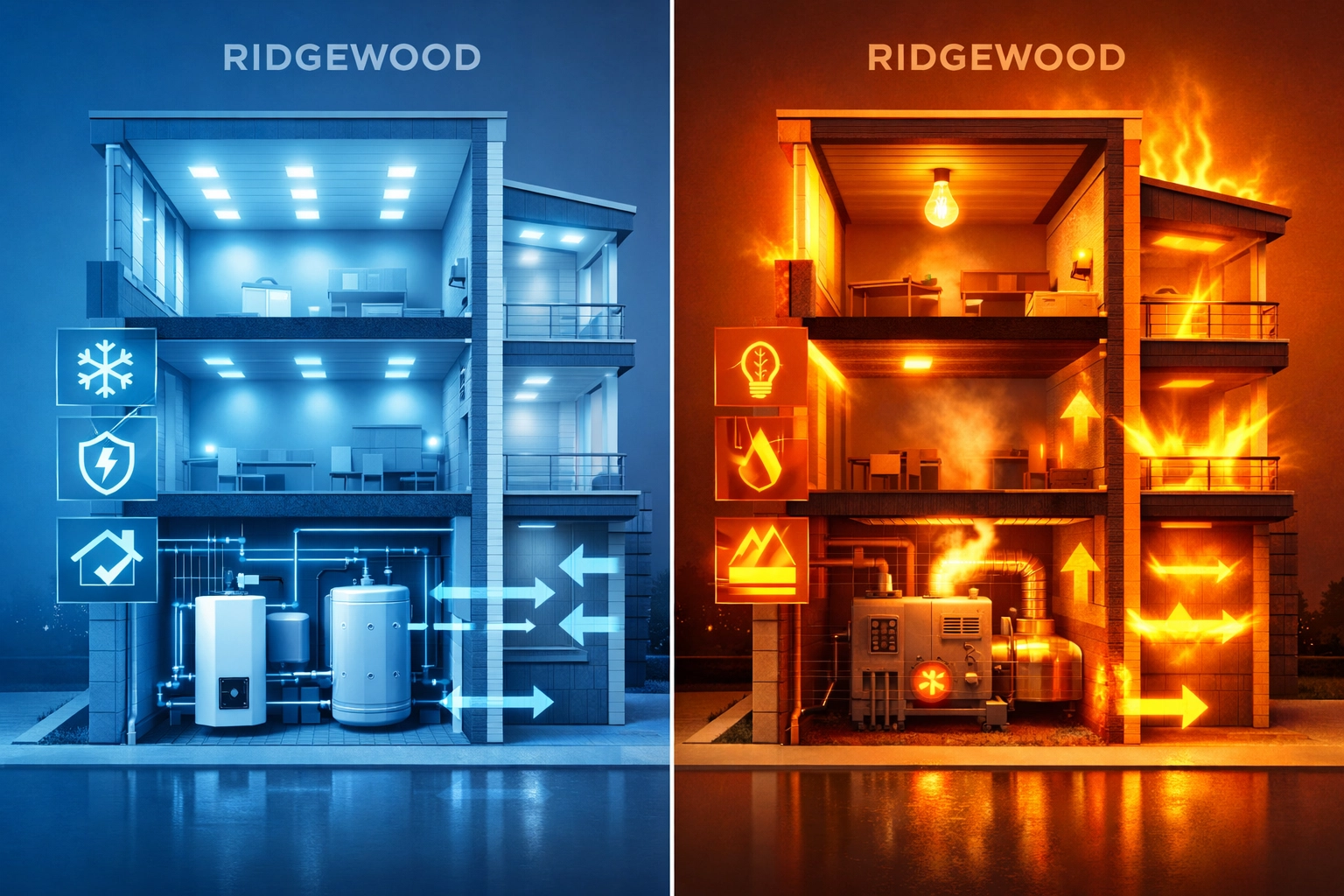
Ridgewood’s building stock includes many pre-war structures with aging mechanical systems. These buildings often hemorrhage money through inefficient heating systems, poor insulation, and outdated lighting: expenses that just get absorbed into “that’s what it costs to run the building.”
Professional management companies increasingly include energy efficiency assessments as part of their service. These audits identify specific improvements that deliver measurable ROI:
For many buildings, these aren’t optional nice-to-haves anymore. Local Law 87 requires energy audits every 10 years for buildings over 25,000 square feet. Local Law 97’s carbon emission caps are pushing buildings toward efficiency upgrades whether they planned for them or not.
A property management company familiar with Queens condo management services can guide boards through available incentive programs: Con Edison rebates, NYSERDA financing, and property tax abatements for qualified improvements: that reduce upfront costs and accelerate payback periods.
One Ridgewood condo reduced their annual heating costs by $12,000 after implementing recommendations from an energy audit coordinated by their management company. Those savings continue year after year, while the audit itself was a one-time expense partially offset by utility rebates.
When evaluating whether professional management makes financial sense, boards need to look beyond the management fee itself. Create a comprehensive comparison:
Self-Management Hidden Costs:
Professional Management True Cost:
For most Ridgewood condos, the math works out favorably once you account for all factors. A building with $300,000 in annual common charges might pay $18,000-$27,000 for management but save $15,000+ through better vendor pricing alone, before factoring in compliance protection and financial systems.
Not all property management firms deliver the cost savings outlined above. When evaluating Queens condo management services, prioritize these qualities:
Full Transparency: Insist on management agreements that prohibit contractor kickbacks and require detailed documentation of all spending. Your management company should provide clear monthly financial statements and make all records easily accessible.
24/7 Availability: Boilers don’t wait for business hours to fail. Look for firms offering round-the-clock emergency response, not just an answering service that takes messages for callback the next day.
No Hidden Fees: The contract should clearly specify what’s included in the base management fee and what constitutes additional charges. Watch for companies that nickel-and-dime boards with separate fees for routine services like lease processing or violation management.
Local Market Knowledge: Ridgewood sits at the Queens-Brooklyn border with a unique housing mix of condos, co-ops, and rental buildings. Choose a firm with specific experience managing properties in Queens and Brooklyn who understand the local market dynamics and vendor ecosystem.
Proven Vendor Network: Ask prospective management companies about their contractor relationships. How many buildings do they manage? How do they vet vendors? Can they provide examples of cost savings they’ve delivered for similar properties?
The goal isn’t just hiring any management company: it’s finding a partner who genuinely reduces your operating costs while improving building operations. The right firm pays for itself through better pricing, smarter budgeting, and protection against expensive mistakes.
For Ridgewood condo boards stretched thin trying to manage buildings themselves, professional property management isn’t an expense: it’s an investment that delivers measurable returns through reduced costs, protected property values, and peace of mind that compliance requirements won’t slip through the cracks.
If your board is spending meetings arguing about vendor quotes, worrying about upcoming inspection deadlines, or trying to make sense of disorganized financial records, it might be time to explore what professional management can do for your building’s bottom line.
If you own a rent-stabilized building in Crown Heights, you've likely heard property owners debate the merits of Major Capital Improvements (MCIs) versus Individual Apartment Improvements (IAIs). Both allow you to increase rents beyond the standard stabilization guidelines, but they function differently, require different levels of approval, and offer very different financial returns. In 2026, with tighter regulations and stricter enforcement from the Division of Homes and Community Renewal (DHCR), understanding which path makes financial sense for your specific building has never been more important.
Major Capital Improvements are building-wide upgrades that benefit all tenants and extend the useful life of your property's essential systems. Think large-scale projects: replacing a boiler, installing new windows throughout the entire building, upgrading the electrical system, re-piping plumbing, or replacing the roof.
The key word here is "building-wide." You can't cherry-pick which apartments receive the improvement. If you're replacing windows, it's all windows or no MCI approval. The DHCR scrutinizes these applications carefully, and tenants have the right to dispute your application if they believe the work wasn't necessary, wasn't completed properly, or if you're seeking reimbursement for work that should have been covered by regular maintenance.

MCIs also come with a critical restriction in 2026: your building cannot have more than 35% non-regulated units. If your Crown Heights property has undergone significant deregulation over the years, you may not qualify for MCI rent increases at all.
Individual Apartment Improvements are exactly what they sound like: upgrades made to a specific unit rather than the entire building. Replacing kitchen cabinets, installing new flooring, upgrading bathroom fixtures, or adding modern appliances all qualify as IAIs.
The catch? For occupied apartments, you need written tenant consent before performing the work. This limits most IAI activity to vacancy periods, when you're preparing a unit for a new tenant. The consent requirement isn't just a formality: without proper documentation, the DHCR can invalidate your rent increase entirely during a future audit or tenant challenge.
IAIs don't require DHCR approval before implementation, which makes them considerably faster to execute. However, you must maintain detailed records including invoices, proof of payment, before-and-after photos, and contractor licenses. If you can't produce this documentation years later when challenged, you'll lose the rent increase.
The financial math between MCIs and IAIs differs significantly, and understanding these mechanics is crucial for Crown Heights property owners working with Property Management Services in Crown Heights to maximize returns.
MCI Financial Structure:
Let's say you spend $50,000 replacing the boiler in a 20-unit Crown Heights building where 15 units are rent-stabilized, each paying approximately $1,800 monthly. The 2% annual cap means each tenant's rent can only increase by $36 monthly ($1,800 x 2% = $36). Across 15 units, you'd collect $540 monthly, or $6,480 annually. At this rate, recovering your $50,000 investment takes roughly 7.7 years: assuming no tenant turnover that might reset the calculation.
IAI Financial Structure:
The 2024 regulations established specific amortization schedules. For Tier One improvements (up to $30,000), larger buildings use a 1/180th amortization schedule, while buildings with 35 or fewer units use 1/168th. Tier Two improvements ($30,001 to $50,000) allow 1/156th amortization in larger buildings and 1/144th in smaller properties.
A $25,000 apartment renovation in a larger Crown Heights building generates approximately $139 monthly ($25,000 ÷ 180 = $138.89). Unlike MCIs, this increase is permanent. Over 15 years, that single unit generates $25,000 in additional rent. Over 30 years, it generates $50,000: double the initial investment.

MCIs work best in specific scenarios that align with both building composition and capital needs:
Building Size and Composition: If you own a majority rent-stabilized building (more than 65% regulated units) in Crown Heights, MCIs distribute cost recovery across multiple units simultaneously. A 40-unit building with 35 rent-stabilized apartments collecting $40 monthly MCI increases generates $1,400 monthly: $16,800 annually. This accelerates payback compared to waiting for individual apartment turnovers.
Essential System Replacements: When your building needs a new roof, boiler replacement, or building-wide electrical upgrade, you don't have the luxury of waiting for vacancies. These aren't improvements you can defer, and MCIs provide the only mechanism to recover these substantial costs through rent increases in stabilized buildings.
Predictable Tenant Base: Buildings with low turnover benefit more from MCIs because the increases remain in place across all units for 30 years. You're not dependent on vacancy timing to implement improvements and capture returns.
Long-Term Investment Horizon: If you plan to hold your Crown Heights property for 15+ years and want to modernize building systems while maintaining rent-stabilized compliance, MCIs provide a path to recovery that doesn't require unit turnover.
IAIs make more financial sense under different circumstances:
Higher Turnover Properties: If your Crown Heights building typically sees 20-30% annual turnover, IAIs allow you to capture permanent rent increases with each vacancy. The lack of DHCR approval requirements means you can move quickly when units become available.
Smaller Buildings: Properties with fewer rent-stabilized units benefit from the faster IAI amortization schedules. The 1/168th rate for buildings with 35 or fewer units means a $20,000 renovation generates $119 monthly: a permanent increase that continues long after costs are recovered.
Market-Rate Preparation: If you're approaching the high-rent vacancy threshold or expect units to deregulate through legal rent increases, IAIs provide permanent boosts that may push units across deregulation limits (where applicable under current law).
Incremental Investment Capacity: Not every landlord has $50,000-$100,000 available for building-wide improvements. IAIs allow you to invest $15,000-$30,000 per unit as turnover occurs, spreading capital expenses across months or years rather than requiring large upfront investments.

Both MCIs and IAIs carry significant compliance requirements that property management companies in Bed-Stuy and Crown Heights must navigate carefully in 2026.
MCI Compliance Considerations:
IAI Compliance Considerations:
The risks intensify for landlords attempting to use both mechanisms simultaneously. If you're pursuing an MCI for building-wide window replacement while also claiming IAI increases for in-unit improvements, you must ensure there's no overlap in claimed costs. Double-dipping: attempting to recover the same expense through both MCI and IAI: results in penalties, reversed increases, and potential DHCR sanctions.
Properties working with professional Property Management Services in Crown Heights typically maintain better documentation standards and avoid common filing errors that trigger DHCR denials.
The choice between MCIs and IAIs isn't binary: many successful Crown Heights landlords use both strategies depending on circumstances. Here's a practical framework:
Start with a building assessment: Identify both immediate capital needs (systems requiring replacement regardless of rent recovery) and potential apartment improvements that could be implemented during turnover. Buildings typically need roof replacements every 20-25 years, boiler replacements every 25-30 years, and window replacements every 30-40 years. These timelines help you anticipate when MCIs become necessary rather than optional.
Calculate your stabilized unit percentage: If you're below 65% rent-stabilized occupancy, MCIs may not provide sufficient cost recovery to justify the DHCR application hassle. Buildings approaching the 35% non-regulated threshold should prepare for eventual MCI ineligibility.
Project your turnover rate: Review the past three years of vacancy data. If you're seeing less than 10% annual turnover, IAIs won't provide frequent enough opportunities for cost recovery. Buildings with 25%+ annual turnover might recover IAI investments faster than MCI expenses.
Consider timing and cash flow: MCIs require substantial upfront capital and 6-12 months before any rent increases take effect. IAIs can be phased across multiple vacancies, reducing immediate cash requirements while generating faster individual unit returns.
Review your violation history: Properties with open violations cannot pursue MCIs. If your building has ongoing HPD or DOB violations, focus on resolving these issues before planning any rent increase strategy. The rent-stabilized compliance requirements extend beyond just improvements: your building must maintain good standing across all regulatory areas.
Many Crown Heights properties face situations where both MCIs and IAIs make sense simultaneously. A building might need a new boiler (clearly an MCI) while also preparing vacant apartments with modern kitchens and bathrooms (IAI work).
The key is proper sequencing and documentation. Complete your MCI work first, file with the DHCR, and maintain entirely separate records for any IAI expenses. Never attempt to include apartment-level work in your MCI application, even if that work was performed as part of a larger building renovation project.
Professional property management companies understand these nuances and maintain the parallel documentation streams required to support both increase types without triggering DHCR scrutiny.
The regulatory environment for rent-stabilized properties continues tightening, with enforcement increasing and penalties for non-compliance becoming more severe. Whether you pursue MCIs, IAIs, or a combination of both, proper documentation and regulatory compliance aren't optional: they're the foundation of any successful rent increase strategy.
For buildings requiring immediate system replacements, MCIs remain the only viable path despite the approval delays and tenant challenge risks. For properties with regular turnover and strong capital reserves, IAIs provide faster implementation and permanent returns.
The landlords seeing the best results in 2026 aren't trying to game the system: they're working with experienced property management companies in Bed-Stuy who understand DHCR requirements, maintain meticulous records, and structure improvement projects to maximize legally compliant returns while keeping buildings in good repair.
Whether your Crown Heights building needs a $75,000 boiler replacement or $20,000 worth of apartment upgrades, the decision between MCIs and IAIs ultimately comes down to building composition, capital availability, turnover patterns, and long-term investment goals. There's no universal right answer: only the right answer for your specific property at this specific moment.
If you own rental property in Brooklyn, you've probably noticed that managing a building in Bed-Stuy feels completely different from managing one in Park Slope. And the costs? They're not exactly apples-to-apples either.
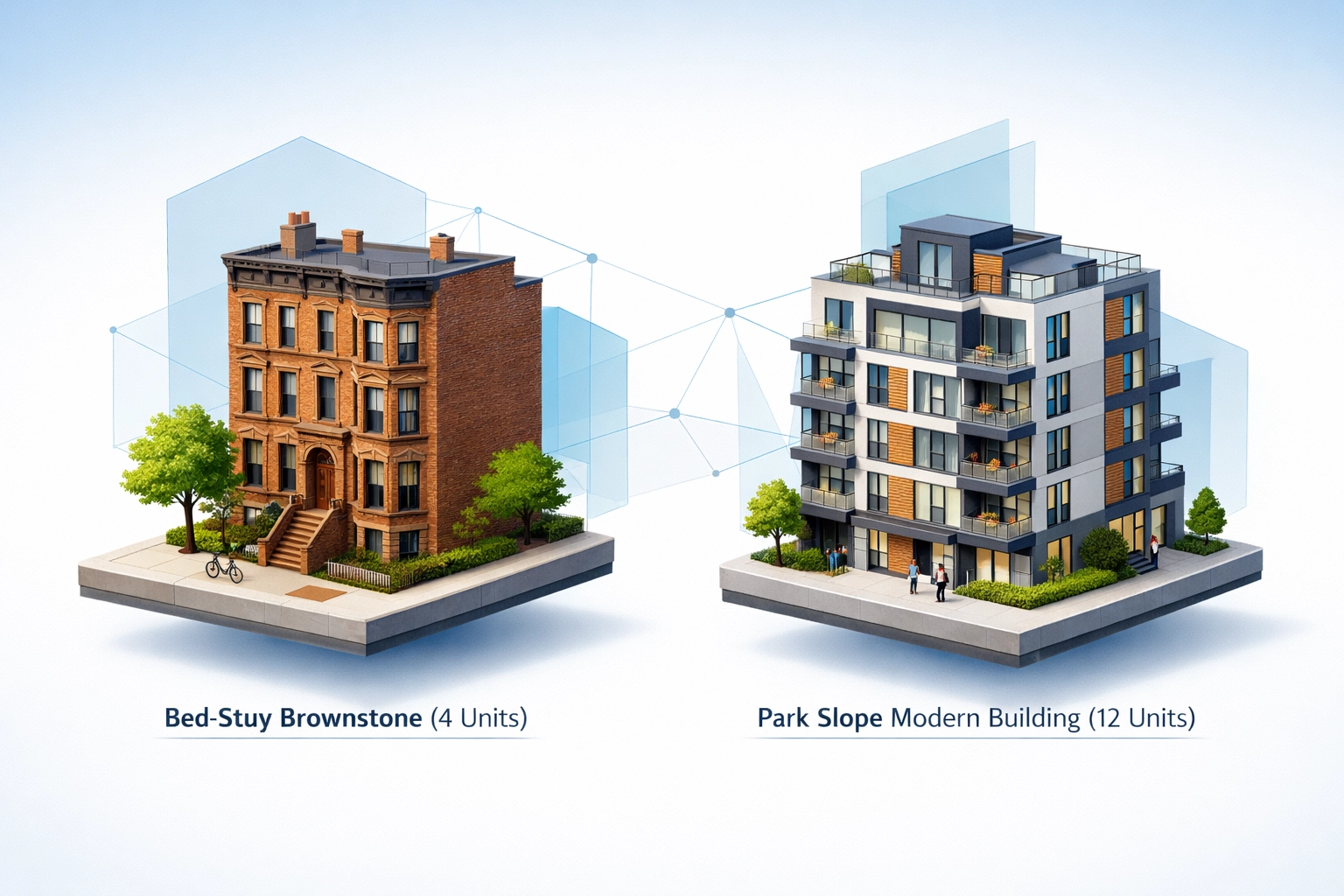
Both neighborhoods have their charm: and their challenges. Bed-Stuy has seen explosive growth over the past decade, with historic brownstones turning into multi-family rentals. Park Slope has long been the go-to for families seeking tree-lined streets and top-tier schools. But when it comes to property management costs in 2026, which neighborhood actually hits your wallet harder?
Let's break it down.
The first thing you need to understand is that these neighborhoods attract different property types, tenant demographics, and regulatory environments.
Bed-Stuy is dominated by:
Park Slope typically features:
These differences set the stage for everything else: from maintenance schedules to tenant communication styles.

The age and structure of your building directly impacts what you'll spend on management.
In Bed-Stuy, you're often dealing with converted brownstones that were never designed to be multi-family rentals. This creates specific challenges:
Park Slope buildings: especially the larger multi-family structures: often have different issues:
The verdict? Park Slope buildings typically have higher individual repair costs when something breaks, but Bed-Stuy buildings break more frequently due to aging infrastructure.
Let's talk numbers. Maintenance costs in both neighborhoods have increased significantly, but for different reasons.
Bed-Stuy Maintenance Challenges:
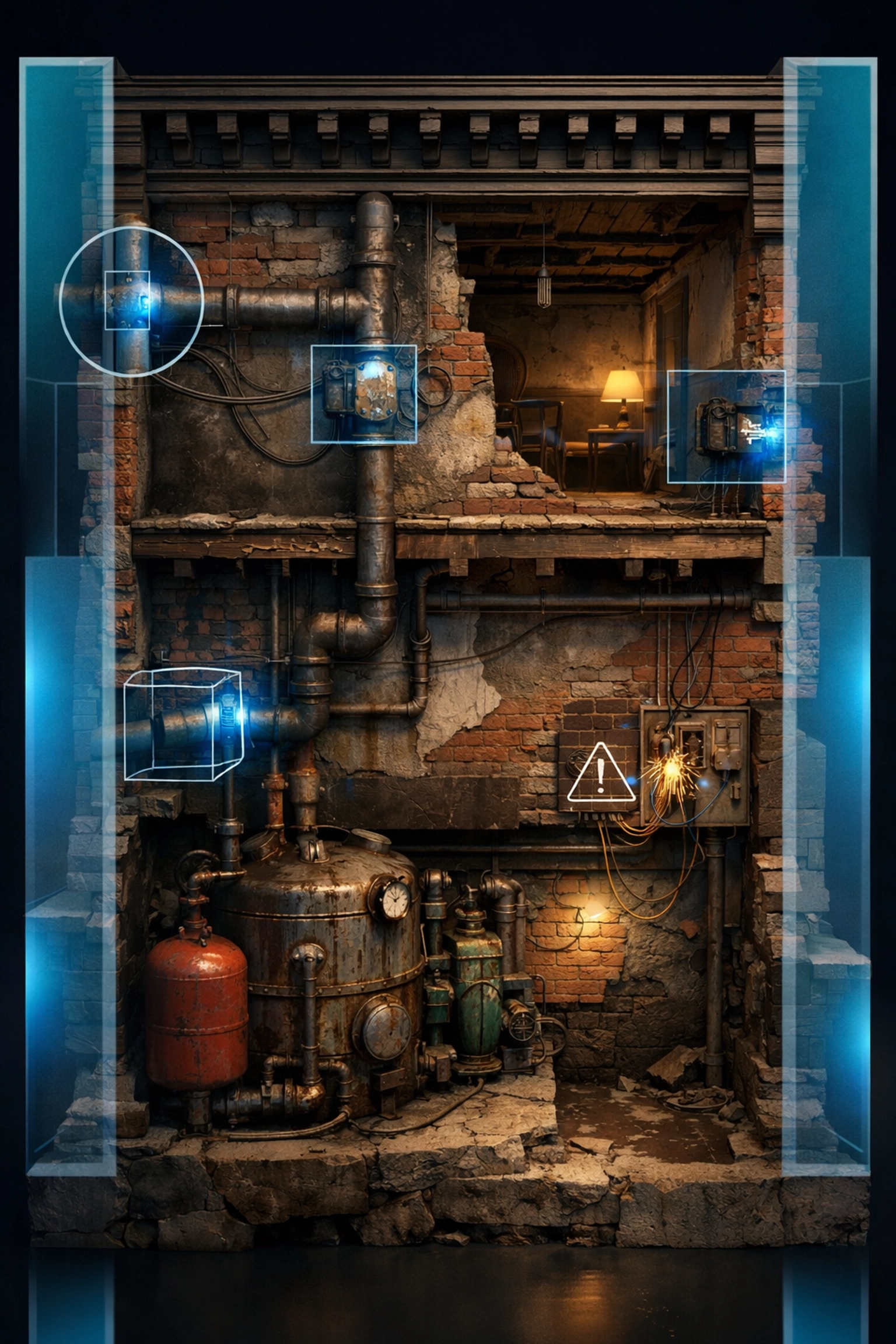
In 2026, emergency repairs in Bed-Stuy average 15-20% higher than Brooklyn's overall average. Why? Aging infrastructure combined with a shortage of contractors familiar with pre-war building systems. You're not just paying for the repair: you're paying for expertise.
Common expenses include:
Park Slope Maintenance Challenges:
Park Slope properties face different cost pressures. Tenant expectations are higher, which means faster response times and premium materials.
Typical expenses:
The maintenance cost winner? It depends on your building's condition, but Bed-Stuy properties with deferred maintenance can easily outpace Park Slope's ongoing costs.
Here's where things get interesting. Rent stabilization dramatically affects management costs: and Bed-Stuy has significantly more rent-stabilized units than Park Slope.
Bed-Stuy and Rent Stabilization:
According to NYC housing data, approximately 40-45% of Bed-Stuy rental units fall under rent stabilization. This creates specific management requirements:
Non-compliance with rent stabilization regulations can result in fines ranging from $1,000 to $5,000 per violation. For property owners unfamiliar with these rules, hiring a property management company with rent-stabilized expertise isn't optional: it's essential.
Park Slope's Market-Rate Reality:
Park Slope has fewer rent-stabilized units (estimated at 15-20% of rentals), which means:
The management cost difference? Rent-stabilized properties require approximately 20-30% more administrative time, which property management companies factor into their pricing.
Tenant expectations directly influence management costs, and these two neighborhoods couldn't be more different.
Bed-Stuy Tenant Profile:
Tenants in Bed-Stuy range from long-term residents who've lived there for decades to young professionals drawn by relative affordability. Communication styles vary widely, but expectations generally include:
Park Slope Tenant Profile:
Park Slope attracts higher-income families and professionals who expect premium service:
Meeting Park Slope expectations requires more hands-on management, which translates to higher costs. A 24/7 maintenance portal isn't a luxury in Park Slope: it's baseline.
Beyond maintenance and tenant management, operating expenses can vary significantly between neighborhoods.
Garbage and Waste Management:
Bed-Stuy properties often have more lenient (read: less expensive) waste management arrangements, but this is changing as the neighborhood develops. Park Slope buildings: especially larger ones: face stricter requirements and higher costs for commercial waste services.
Average costs in 2026:
Vendor Availability and Pricing:
Park Slope's established infrastructure means more vendor competition, which can actually lower costs for routine services. However, premium service expectations drive prices back up.
Bed-Stuy faces a different challenge: fewer contractors specializing in historic building maintenance, which creates higher prices due to limited supply.
Utilities and Common Area Costs:
Buildings with landlord-paid utilities face different cost structures:
After analyzing building types, maintenance, rent stabilization, tenant expectations, and operating expenses, here's the truth: it depends on your specific property.
However, we can make some generalizations:
Bed-Stuy properties typically cost more to manage when:
Park Slope properties typically cost more to manage when:
The management fee structure itself usually ranges from 8-12% of collected rent in both neighborhoods, but the total cost of ownership can vary by 20-40% depending on these factors.
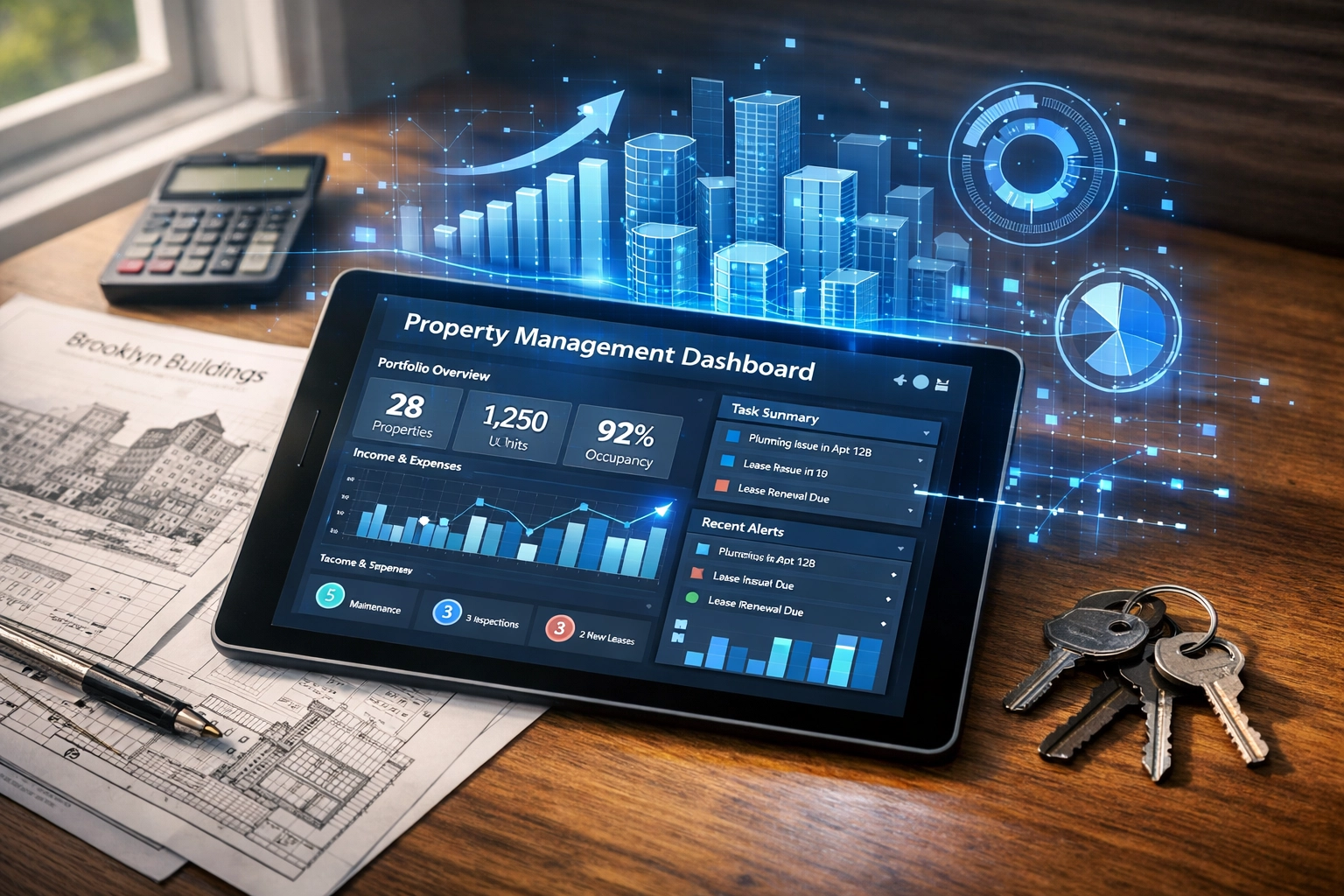
Whether you own in Bed-Stuy or Park Slope, the right property management partner can significantly impact your bottom line.
Professional management companies like Landlord Management (LLM) offer advantages that individual owners simply can't replicate:
Transparent Pricing:
No hidden fees regardless of whether your building is in Bed-Stuy or Park Slope. You know exactly what you're paying and what you're getting.
Rent Stabilization Expertise:
Critical for Bed-Stuy owners, this expertise prevents costly violations and ensures compliance with DHCR regulations. LLM's team stays current on all rent stabilization requirements, protecting you from penalties.
24/7 Maintenance Portal:
Meets the high expectations of Park Slope tenants while providing efficient service to Bed-Stuy residents. Modern technology doesn't have to mean higher costs: it actually improves response times and reduces emergency expenses.
Combined Buying Power:
Managing properties across both neighborhoods means better vendor relationships and negotiated rates. Those savings get passed directly to property owners.
Local Market Knowledge:
Understanding neighborhood-specific challenges: from Local Law 97 compliance to inspection requirements: helps prevent surprise expenses.
Managing property in Bed-Stuy versus Park Slope isn't about one neighborhood being categorically more expensive than the other. It's about understanding the specific challenges each presents and planning accordingly.
Bed-Stuy demands expertise in aging buildings, rent stabilization compliance, and navigating a rapidly changing neighborhood. Park Slope requires premium service delivery, attention to detail, and managing higher tenant expectations.
The most successful property owners in both neighborhoods share one thing in common: they partner with experienced management companies that understand these nuances and can navigate them efficiently.
Whether you're managing a converted brownstone in Bed-Stuy or a multi-family building in Park Slope, the real question isn't which costs more: it's whether you have the right team to optimize those costs while maximizing your property's value.
DUMBO (Down Under the Manhattan Bridge Overboard) has transformed from industrial warehouses into one of New York's most prestigious neighborhoods over the past two decades. Today's multi-family property owners in DUMBO face a unique challenge: managing buildings that command luxury rental rates while dealing with converted industrial infrastructure, landmark preservation requirements, and tenants who expect white-glove service.
Unlike managing a traditional Brooklyn brownstone or a standard Manhattan high-rise, DUMBO property management requires specialized knowledge of mixed-use regulations, warehouse conversion maintenance, and the expectations of a high-income tenant base. If you own a multi-family building in DUMBO: whether it's a converted loft building on Water Street or a modern development near Brooklyn Bridge Park: understanding what separates effective property management from mediocre service can mean the difference between a thriving investment and constant headaches.
DUMBO's property landscape doesn't fit the standard Brooklyn mold. The neighborhood features converted industrial warehouses with exposed brick, original timber beams, and oversized windows: architectural features that require specialized maintenance knowledge. These buildings often include commercial spaces on ground floors with residential units above, creating a mixed-use management scenario that requires expertise in both residential and commercial regulations.
The tenant demographic in DUMBO skews toward tech professionals, creative industry workers, and corporate executives who expect amenities and service levels typically found in luxury Manhattan buildings. These residents pay premium rents (often $4,000-$8,000+ for two-bedroom units) and have correspondingly high expectations for maintenance response times, building amenities, and communication from property management.

Additionally, many DUMBO buildings fall under landmark preservation guidelines due to the historic district designation. This means routine maintenance decisions: from window replacements to facade repairs: require coordination with the Landmarks Preservation Commission, adding complexity and timeline considerations that don't exist in most Brooklyn neighborhoods.
The cobblestone streets, while charming, present their own challenges for service access, garbage collection, and delivery coordination. Property managers in DUMBO need relationships with vendors who understand these logistical quirks and can navigate them efficiently.
The foundation of effective property management in DUMBO starts with three non-negotiable service areas: financial transparency, maintenance responsiveness, and regulatory compliance.
Financial Management and Bookkeeping
DUMBO property owners need more than basic rent collection. Comprehensive financial services should include:
Transparency matters particularly in DUMBO because the high property values and rental rates mean even small percentage inefficiencies translate to significant dollar amounts. A property management company charging "market rates" while adding hidden vendor kickbacks or inflated service fees can cost owners tens of thousands annually on a 20-unit building.
24/7 Maintenance and Emergency Response
When a tenant paying $6,000 monthly rent experiences a plumbing leak or HVAC failure, they expect immediate response. Property management services in DUMBO must include:

The distinction between adequate and excellent maintenance management becomes clear during winter months when heating systems in converted warehouses face unique challenges due to high ceilings and large windows. A property manager who understands these building-specific issues can prevent tenant complaints and expensive emergency repairs.
Rent Stabilization and Regulatory Compliance
Even in luxury neighborhoods like DUMBO, rent stabilization regulations apply to certain units. Effective DUMBO multi-family property management requires expertise in:
Mishandling rent stabilization compliance can result in penalties, tenant harassment claims, and forced rent rollbacks that devastate property cash flow. A property management company in Brooklyn with specific rent stabilization expertise protects owners from costly mistakes.
DUMBO's operational costs run higher than most Brooklyn neighborhoods. Property taxes on waterfront buildings reflect premium assessments, vendor rates account for difficult access and parking challenges, and tenants expect amenity-level services. Managing these costs without sacrificing service quality requires strategic approaches.
Vendor Management and Bulk Purchasing Power
Individual building owners typically negotiate vendor contracts from a weak position: vendors know they're dealing with a single property and price accordingly. Property management companies serving multiple buildings can leverage combined purchasing power for:
These economies of scale can save multi-family owners 15-30% on recurring service contracts compared to negotiating independently. On a building spending $50,000 annually on these services, that's $7,500-$15,000 in direct savings.
Budget Analysis and Cost Control
Effective financial management in DUMBO requires comparing actual expenses against neighborhood benchmarks. Are you paying $2.50 per square foot for porter services when similar buildings pay $1.80? Is your elevator maintenance contract priced appropriately for a 6-story building, or are you being overcharged?

Professional property management companies maintain databases of comparable operating costs across their portfolio. This data allows them to identify when a building's expenses drift above market rates and negotiate corrections. They can also forecast major capital expenses: roof replacements, facade work, elevator modernization: before they become emergencies requiring expensive rushed contracts.
DUMBO residents aren't just paying for apartments: they're paying for a lifestyle and level of service. Understanding tenant expectations helps prevent turnover, which remains the most expensive operational cost for multi-family owners (marketing costs, vacancy periods, turnover preparation, and potential rent concessions).
Digital Communication and Payment Options
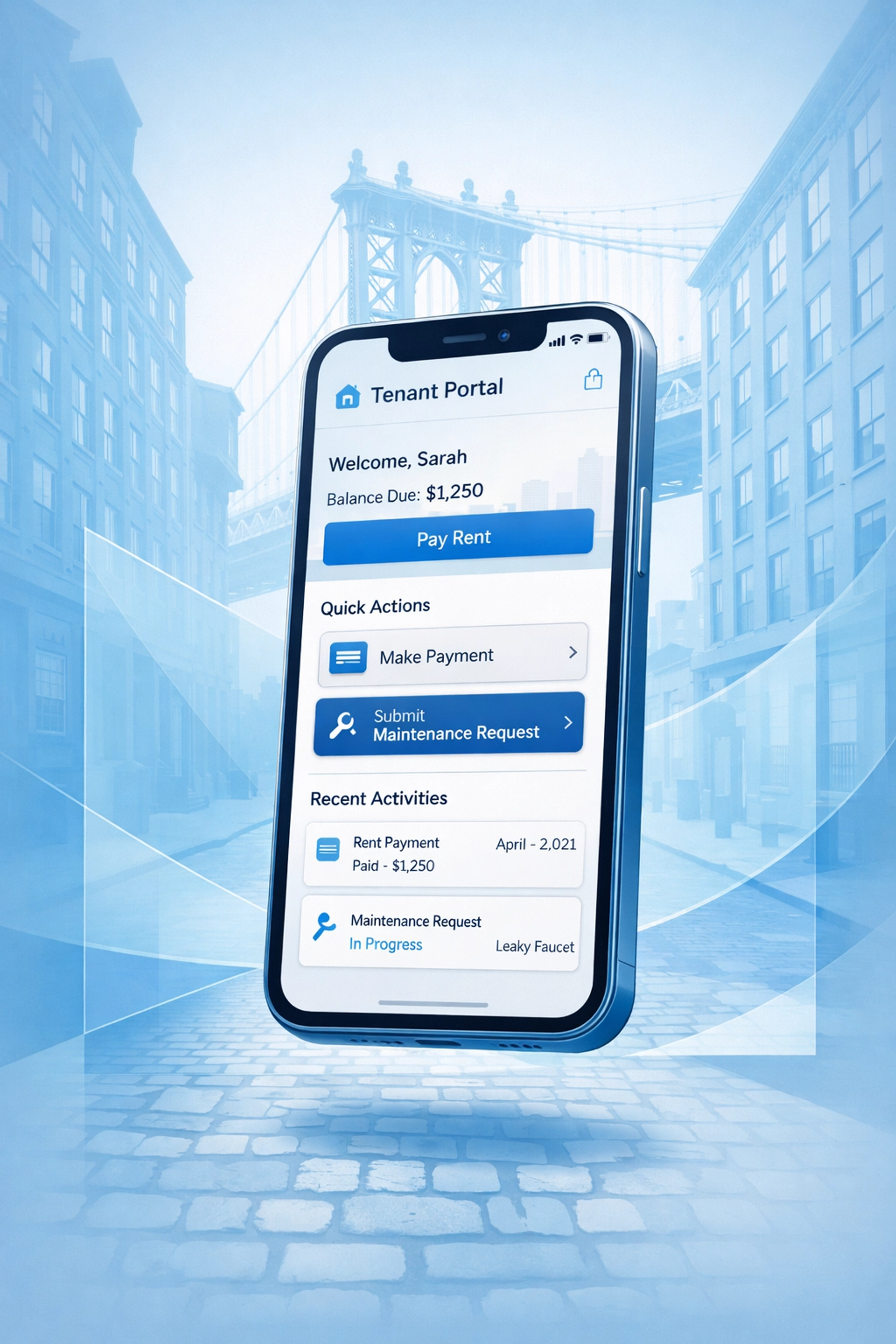
Tenants in DUMBO work in tech and creative industries. They expect digital-first communication tools:
Property management companies still relying on paper-based processes or phone-only maintenance requests will frustrate DUMBO's digitally-native tenant base. The expectation is seamless, app-based interaction: similar to what these tenants experience in every other aspect of their lives.
Amenity Management and Community Building
While not every DUMBO multi-family building can offer the full amenity package of new luxury developments, tenants increasingly expect:
These expectations require active property management involvement: not just collecting rent and responding to emergencies. Buildings that invest in tenant experience see longer lease terms and lower turnover rates.
Selecting property management services in Brooklyn requires evaluating both general competence and DUMBO-specific expertise. The right property management company in DUMBO should demonstrate several key qualities.
Transparent Fee Structures
Beware of property management companies advertising low base rates (like 4-5% of collected rent) but then adding fees for every service imaginable: lease renewal fees, maintenance coordination fees, inspection fees, and administrative charges. These "hidden" costs can effectively double your actual management expenses.
Look for companies offering all-inclusive pricing that covers standard management activities. Landlord Management (LLM) provides full financial transparency with no hidden fees: you know exactly what you're paying and what services that includes. This pricing clarity matters particularly for DUMBO owners managing high-value properties where percentage-based fees already represent substantial monthly costs.
Licensed Contractors and Insurance Requirements
Given DUMBO's high property values and landmark preservation requirements, working with properly licensed and insured contractors isn't optional: it's essential. Ask potential property management companies:
Professional property management companies like LLM maintain strict contractor vetting processes and carry appropriate liability insurance to protect building owners. This becomes particularly important when work involves landmark-designated features or shared systems in mixed-use buildings.
Local Market Knowledge
Understanding DUMBO specifically matters. A property management company might excel in managing Midtown Manhattan co-ops but struggle with the unique challenges of converted DUMBO warehouses. Look for demonstrated experience with:
Companies serving multiple neighborhoods across Brooklyn and Queens can bring cost advantages through bulk purchasing power while maintaining local expertise. LLM's combined buying power for services like cleaning and garbage collection delivers cost savings without sacrificing DUMBO-specific knowledge.
Communication Standards and Availability
DUMBO tenants expect quick responses to maintenance issues and questions. Your property management company should offer:
The property management relationship works best when owners receive consistent updates without having to constantly chase information. Monthly financial reports, quarterly maintenance summaries, and annual budget reviews should arrive automatically.
Managing multi-family properties in DUMBO requires balancing luxury tenant expectations with the operational realities of converted industrial buildings, landmark regulations, and premium neighborhood costs. The right property management partner brings specialized expertise in these areas while delivering the financial transparency and service responsiveness that DUMBO ownership demands.
Whether you own a 12-unit converted warehouse on Washington Street or a 40-unit modern development near Brooklyn Bridge Park, effective property management services in Brooklyn should maximize your property's financial performance while minimizing operational headaches. Focus on companies demonstrating transparent pricing, DUMBO-specific expertise, licensed contractor networks, and modern tenant communication tools.
For multi-family owners seeking DUMBO property management that combines local expertise with institutional-grade financial controls and 24/7 customer care, Landlord Management (LLM) offers comprehensive services designed for the unique demands of Brooklyn's premium neighborhoods. The investment in professional management pays for itself through reduced vacancy rates, controlled operating costs, and protection from regulatory compliance mistakes.
If you own a rent-stabilized building in Crown Heights, you've probably asked yourself this question at least once: "Should I even bother upgrading this place if I can barely recoup the costs?"
It's a fair question. Between the Housing Stability and Tenant Protection Act (HSTPA) reforms of 2019 and the evolving NYC regulations in 2026, the math on Major Capital Improvements (MCIs) and Individual Apartment Improvements (IAIs) has changed dramatically. What used to be a straightforward way to increase rent and recover improvement costs is now… let's just say it's complicated.
Here's the good news: some improvements still make financial sense, if you know which ones to prioritize and how to navigate the regulatory maze. Let's break it down.
Before we get into the dollars and cents, let's clarify what we're talking about.
Major Capital Improvements (MCIs) are building-wide upgrades that benefit all tenants and extend the useful life of your property. Think big-ticket items like:
These improvements are essential for maintaining your building's infrastructure and often can't be deferred indefinitely without serious consequences (hello, emergency repairs at 2 AM).
Individual Apartment Improvements (IAIs), on the other hand, are upgrades specific to a single unit. These include:
Under pre-2019 rules, landlords could more easily recoup IAI costs through rent increases. Post-HSTPA? That's a different story.

Here's where things get interesting (and by interesting, we mean frustrating). The 2019 HSTPA reforms fundamentally changed the economics of both MCIs and IAIs for rent-stabilized buildings in Brooklyn.
First, your building must have more than 35% rent-regulated units to even qualify for MCI rent increases. If 35% or fewer of your apartments are rent-stabilized, MCIs are off the table entirely.
If you do qualify, here's what you're working with in 2026:
Let's say you spend $300,000 on a new boiler for your 20-unit building. You amortize that over 12 years, which gives you $25,000 annually to collect across all units. But with the 2% cap per tenant, you're limited in how quickly you can actually collect that money, especially if you have long-term tenants paying below-market rents.
IAIs got hit even harder by the reforms:
Here's a sobering example: You drop $40,000 renovating a vacant apartment in your Crown Heights walk-up (new kitchen, bathroom, floors, the works). Under the old rules, you might have collected $1,000 monthly. In 2026? You're looking at roughly $89.29 per month (assuming a building under 35 units).
At that rate, you'd need about 37 years to recover your costs, but the law only allows you to collect for 30 years. You're literally locked into a financial loss on paper.
Even when the math theoretically works, many property management companies in Crown Heights see MCI and IAI applications denied because of paperwork errors. The Division of Homes and Community Renewal (DHCR) doesn't mess around.
Documentation errors that kill MCI applications:
IAI denial red flags:
One Crown Heights landlord we know spent $18,000 on a unit renovation, submitted the IAI application, and got denied because the contractor's invoice didn't itemize labor vs. materials. Start over, resubmit, wait another 6–9 months. Not ideal.

Given the financial constraints, here's the uncomfortable truth: you're probably not doing major improvements purely for the rent increase anymore. Instead, you need to think strategically about long-term operating costs, property value, and tenant retention.
Some MCIs, despite the slow cost recovery, can dramatically reduce your monthly expenses:
Energy-efficient windows: Yes, the upfront cost is steep (think $150,000+ for a multi-family building). But well-insulated windows can cut your heating bills by 20–30% annually. In a Crown Heights brownstone conversion with oil heat, that's real money. Plus, tenants are happier when their apartments aren't drafty in January.
High-efficiency boilers: Modern condensing boilers can reduce fuel consumption by 15–25% compared to older models. If you're spending $40,000 annually on heat, a new boiler might save you $8,000–$10,000 per year. That's a 7–10 year payback period independent of rent increases.
LED building-wide lighting and smart thermostats: Smaller-scale upgrades, but they chip away at your electric bills and qualify as MCIs if done building-wide.
When rent-stabilized units eventually turn over (vacancy, succession rights expire, etc.), having a well-maintained building with modern systems is gold. A building with a brand-new roof, updated electrical, and efficient heating is worth significantly more than one limping along with deferred maintenance.
If you're planning to sell your Crown Heights property in the next 5–10 years, MCIs can boost your asking price even if they don't immediately pay for themselves through rent increases.
Spending $25,000 to give a unit a Pinterest-worthy makeover might feel good, but the math doesn't support it under current rent stabilization laws: unless you're preparing for a market-rate turnover or trying to attract a higher-quality tenant pool for long-term retention.
Focus IAI dollars on improvements that tenants actually value and that reduce your maintenance headaches: durable flooring, quality appliances that won't break in two years, updated plumbing fixtures that don't leak.

Look, we get it: this stuff is overwhelming. Between tracking 15-year IAI caps, ensuring contractors are licensed and insured, filing DHCR paperwork correctly, and actually managing the construction process, it's a full-time job.
That's where a property management company in Crown Heights with actual rent stabilization expertise comes in handy.
Here's how LLM makes this easier:
Project Management and Contractor Oversight: We work with a vetted network of licensed and insured contractors who know the MCI/IAI game inside and out. No unlicensed handymen, no missing permits, no invoices that raise red flags at DHCR.
Full Transparency and Documentation: We handle all bookkeeping and reporting with zero extra charges. Every invoice, every permit, every photo: organized and ready for your DHCR filing. We've seen too many applications denied over sloppy paperwork.
Rent Stabilization Compliance: Our team stays current on rent-stabilized property management requirements so you don't have to become a DHCR regulation expert. We'll flag potential issues before they become expensive problems.
ROI Analysis: Before you commit to a $200,000 MCI, we run the numbers. What's the realistic payback period? How will this affect your operating costs? Is there a smarter phased approach? We help you make decisions based on actual data, not wishful thinking.
MCIs and IAIs in 2026 are no longer the easy money-makers they once were. The HSTPA reforms deliberately tilted the scales toward tenant protection, and that's the reality we're working with.
But that doesn't mean improvements are pointless. You just need to be strategic:
Your Crown Heights building is a long-term investment. Sometimes the smartest move isn't about maximizing this year's rent roll: it's about positioning your property to perform better over the next decade.
Need help figuring out which improvements make sense for your specific building? Contact us for a free consultation. We'll run the numbers, review your building's condition, and give you straight talk about what's worth doing and what's not.
No BS, no upsells: just practical advice from people who deal with this stuff every day in Brooklyn.
If you've ever watched your heating bill climb while tenants still complain about the cold, you know the frustration. NYC winters don't play around, and neither do HPD violations. The good news? You don't need to gut your building or drain your reserves to make a real difference.
Whether you own a brownstone in Brooklyn Heights or a multi-family in Astoria, these five budget-friendly insulation upgrades can help you keep tenants warm, stay compliant with NYC heat laws, and avoid those middle-of-the-night emergency calls about frozen pipes.
Let's break it down.
Before we dive into the fixes, let's talk about why this matters beyond just comfort.
New York City has strict heat season requirements. From October 1st through May 31st, landlords must maintain indoor temperatures of at least 68°F during the day (when outdoor temps fall below 55°F) and 62°F at night. Fall short, and you're looking at HPD violations, potential fines, and some very unhappy tenants.
Poor insulation doesn't just make your building uncomfortable: it forces your heating system to work overtime. That means:
The reality is that many buildings in Brooklyn and Queens are older. Pre-war construction wasn't exactly designed with modern energy efficiency in mind. But that doesn't mean you need a massive renovation budget to make meaningful improvements.

Here's where it gets practical. These five upgrades won't break the bank, but they can make a noticeable difference in heat retention and tenant satisfaction.
This is the low-hanging fruit of winterizing rental properties: and honestly, it's where most buildings lose the most heat.
Those tiny gaps around window frames and door edges might not look like much, but they add up fast. In a typical NYC apartment, air leaks around windows and doors can account for 25-30% of heating energy loss. That's like leaving a window cracked open all winter.
What to do:
Cost estimate: $5-15 per window or door for materials. If you're hiring out, expect $50-100 per unit for a thorough job.
The ROI here is excellent. A proper seal job can reduce heating costs by 10-15% and dramatically cut down on tenant complaints about drafty apartments.
Sometimes the windows themselves are the problem. Single-pane windows (common in older Brooklyn and Queens buildings) are basically thermal sieves. Replacing them is expensive: we're talking $500-1,000+ per window installed.
But here's a workaround that costs a fraction of that.
Thermal curtains are heavy, insulated drapes that create an additional barrier between the cold glass and the living space. They're especially effective at night when temperatures drop and heat loss accelerates.
Window film is another option: a thin, transparent plastic layer that creates an insulating air pocket when applied with heat. It's not the most attractive solution, but it works surprisingly well.
What to consider:
Cost estimate: $20-50 per window for quality thermal curtains; $10-20 per window for film kits.
For property owners managing multiple units, buying in bulk can bring these costs down significantly. A good property management company in Brooklyn can help you source materials at better rates through vendor relationships.

Here's one that often gets overlooked: the gap under apartment doors.
In multi-family buildings, hallways can act like wind tunnels. Cold air enters through the building entrance, travels through common areas, and sneaks into units through the space under doors. Even well-heated apartments can feel drafty if that gap isn't addressed.
Door sweeps are simple devices that attach to the bottom of doors to block airflow. They're cheap, easy to install, and make an immediate difference.
What to do:
Cost estimate: $10-25 per door for materials; installation takes about 15-20 minutes per door.
This is a perfect project for building supers or maintenance staff. For larger buildings, coordinating the work through an online portal keeps everything documented and on schedule.
Frozen pipes aren't just an inconvenience: they're a potential disaster. A single burst pipe can cause thousands of dollars in water damage, displace tenants, and create a compliance nightmare.
But even if your pipes don't burst, uninsulated pipes in cold spaces (basements, crawl spaces, exterior walls) lose heat constantly. That hot water traveling from your boiler to the radiators? It's cooling down before it even gets there.
Pipe insulation is one of the best returns on investment for any building.
What to do:
Cost estimate: $1-3 per linear foot for foam insulation; heat tape runs $10-20 per 6-foot section.
For a typical Brooklyn brownstone, you might spend $200-400 on materials to insulate exposed basement pipes. Compare that to the cost of a burst pipe repair (easily $2,000-5,000+), and the math speaks for itself.

Heat rises. That's basic physics. And in a building with a poorly sealed attic hatch or roof access point, a significant portion of your heating investment is literally floating away.
Attic hatches, roof access doors, and bulkhead entrances are often overlooked because they're out of sight. But these openings can be massive sources of heat loss: especially in buildings where the attic space isn't insulated.
What to do:
Cost estimate: $50-150 per access point for a thorough seal-and-insulate job.
This is one of those upgrades that pays dividends for years. A properly sealed attic hatch can reduce overall heating costs by 5-10%, depending on building size and configuration.
Look, we get it: you didn't become a property owner to spend your weekends caulking windows and measuring door sweeps. That's where having the right support makes a difference.
At Landlord Management (LLM), we help Brooklyn and Queens property owners stay ahead of winter maintenance through:
Whether you're managing a single building or a portfolio across multiple neighborhoods, having a system in place for property management in Queens and Brooklyn means fewer emergencies and more predictable costs.
Winterizing rental properties doesn't have to be expensive or complicated. These five upgrades: weatherstripping, thermal curtains or film, door sweeps, pipe insulation, and attic sealing: can be completed for a few hundred dollars per unit and deliver real savings on heating costs.
More importantly, they help you avoid the headaches that come with NYC heat law violations and tenant complaints. In a market where good tenants are worth keeping, a warm, well-maintained building is a competitive advantage.
Ready to get your buildings prepped for the next big freeze? Reach out to our team to talk about how we can help coordinate your winterization projects( before the temperature drops.)
Let's be real: nobody wants HPD knocking on their door. But every year, Brooklyn landlords rack up thousands of dollars in violations because they made avoidable mistakes during Heat Season. And here's the kicker, most of these mistakes happen not because owners don't care, but because they didn't know the rules (or forgot them until it was too late).
If you own rental property in Brooklyn, this post is your cheat sheet. We're breaking down the seven most common Heat Season blunders and showing you exactly how to sidestep them before the city comes calling.
Heat Season in New York City runs from October 1 through May 31, that's eight full months where you're legally required to keep your tenants warm. It's not a suggestion. It's the law.
During this period, HPD enforces strict temperature minimums in residential buildings. Fail to meet them, and you're looking at Class C hazardous violations. These carry penalties ranging from $250 to $500 per day for first-time offenses, jumping to $500 to $1,000 per day for repeat violations.
Translation? A week of non-compliance could easily cost you more than your boiler repair would have.
Now let's get into the mistakes.
You'd be surprised how many Brooklyn landlords get caught off guard by October 1st. Summer lingers, the weather's still mild, and suddenly you're scrambling because a tenant filed a complaint and your boiler hasn't been touched since April.
Heat Season is mandatory. It doesn't matter if it's 70 degrees outside on October 3rd, if your building can't deliver heat when needed, you're already exposed.
The fix: Mark October 1st on your calendar like it's tax day. Schedule your boiler inspection and maintenance for mid-September so you're ready to roll when the season officially kicks off.

Here's where NYC Heat Season laws get specific. Between 6 AM and 10 PM, if the outside temperature drops below 55°F, you must maintain at least 68°F inside tenant-occupied spaces. Between 10 PM and 6 AM, the indoor minimum is 62°F, regardless of what's happening outside.
Many landlords assume they're in the clear during that 55°F to 62°F "gray zone" during the day. But here's the trap: if you're not already heating the building, you'll never hit the 62°F nighttime requirement by 10 PM.
HPD inspectors measure temperatures using calibrated thermometers positioned three feet from exterior walls, not in hallways, but in actual living rooms and bedrooms.
The fix: Don't play temperature roulette. Keep baseline heating running so you're never caught short when nighttime rolls around.
Here's a fun fact that trips up a lot of property owners: hot water requirements aren't seasonal. You're required to provide water at a minimum of 120°F every single day of the year, yes, including July.
A tenant complaint about lukewarm water in the middle of summer carries the same weight as a heat complaint in January. And in buildings with combination boilers (handling both heat and hot water), space heating during winter can actually cause hot water temps to drop below the minimum.
The fix: Have a licensed master plumber inspect your system annually, specifically checking that your boiler can maintain adequate hot water while also meeting heating demands. Don't wait for a complaint to find out there's a problem.

We get it: preventive maintenance feels like spending money on something that isn't broken. But here's the math: a mid-winter boiler failure in a Brooklyn building means emergency repair costs (often at premium rates), potential HPD violations Brooklyn landlords dread, and a whole lot of angry tenants.
Boilers don't fail quietly. They fail spectacularly, usually on the coldest night of the year when every HVAC contractor in the city is already booked.
The fix: Schedule annual boiler inspections before Heat Season begins. Check for common culprits like air locks in radiators, faulty thermostats, and electrical failures. A $300 tune-up beats a $3,000 emergency call every time.
At Landlord Management (LLM), we set up preventive maintenance schedules for boilers and heating systems so our clients never face a surprise breakdown. It's one of those "boring" services that saves owners thousands.
When a tenant calls 311 about no heat or hot water, the clock starts ticking immediately. HPD doesn't care if you were on vacation, if it was 2 AM, or if you "didn't see the email."
Class C violations for heat and hot water failures require actual temperature restoration within 24 hours: not just a repair plan, but documented proof that the problem is fixed. Time-stamped temperature measurements are your friend here.
The fix: You need a system for receiving and responding to complaints around the clock. Whether that's a dedicated phone line, an emergency protocol with your super, or a property management company handling it for you, response time is everything.
This is exactly why we offer 24/7 emergency maintenance response for heat and hot water calls. When a complaint comes in at midnight, our licensed and insured contractors are already on the way.

Sometimes the boiler is fine, but the tenant doesn't know how to bleed a radiator. Sometimes there's a repair scheduled for tomorrow, but nobody told the tenant. Sometimes the super fixed the issue, but didn't follow up.
Poor communication turns minor problems into major complaints. Tenants who feel ignored are more likely to call 311. Tenants who feel informed are more likely to wait for a scheduled repair.
The fix: Create a clear channel for tenants to report issues and receive updates. A secure online portal where tenants can submit work orders instantly: and track their status: eliminates the "I never heard back" complaints that escalate to HPD.
At LLM, our tenant portal does exactly this. Tenants submit requests, we dispatch contractors, and everyone stays in the loop. No more phone tag, no more "he said, she said."
Here's a sneaky one. You can have a perfectly functioning boiler and still fail temperature checks because your building is hemorrhaging heat through uninsulated hallways, stairwells, and common areas.
Drafty windows, gaps around doors, and poor insulation in basements and roofs all contribute to heat loss. Your boiler works overtime, your energy bills spike, and your tenants' apartments still feel cold.
The fix: Walk your building before Heat Season and identify problem areas. Weather stripping, caulking, and basic insulation upgrades can make a significant difference. For older Brooklyn buildings, this kind of maintenance often gets overlooked: but it's low-hanging fruit for improving tenant comfort and reducing operating costs.
If you're managing a larger portfolio, check out our Brooklyn property management checklist for more tips on keeping buildings compliant and efficient.
The pattern here is pretty clear: most Heat Season violations stem from delayed action, poor planning, or communication gaps. The landlords who avoid HPD headaches are the ones who:
If managing all of this sounds exhausting: especially if you own multiple properties: that's where a solid property management company in Brooklyn can take the load off.
At Landlord Management (LLM), we handle Heat Season compliance so you don't have to white-knuckle it through every cold snap. From preventive boiler maintenance to 24/7 emergency response to tenant communication portals, we've built our systems around keeping Brooklyn landlords violation-free.
Heat Season isn't going anywhere, and neither are HPD's temperature requirements. The good news? Every mistake on this list is 100% preventable with a little planning and the right support.
Don't wait for a violation notice to find out your building has a problem. Get ahead of it now, and you'll thank yourself when January hits and your tenants are warm, your boiler is humming, and HPD has no reason to come knocking.
Questions about Heat Season compliance or property management in Brooklyn? Reach out to our team( we're happy to help.)
If you own rental property in Brooklyn Heights, you've probably heard the phrase "Good Cause Eviction" tossed around at owner meetups, in online forums, or maybe from your attorney. But here's the thing: a lot of landlords still don't fully understand how this law affects their day-to-day operations, their bottom line, or their ability to manage tenants effectively.
Good Cause Eviction isn't brand new. It's been on the books since April 2024. But as we settle into 2026, the practical implications are becoming clearer, and the consequences of non-compliance are getting real. Whether you own a brownstone with a handful of units or a mid-size building on Montague Street, understanding NYC tenant laws 2026 is no longer optional: it's essential.
Let's break it down.
At its core, Good Cause Eviction is a tenant protection law that applies to market-rate (unregulated) rental units in New York State. Before this law, landlords could generally decline to renew a lease without providing a specific reason. Now? You need a legally recognized "good cause" to remove a tenant from their home.
The law was designed to provide stability for renters who don't benefit from rent stabilization protections. For Brooklyn Heights landlords, this means a significant shift in how you approach lease renewals, rent increases, and eviction proceedings.

Not every unit falls under Good Cause Eviction. Here's a quick breakdown of what's covered and what's exempt:
The law applies to tenants who:
The law does NOT apply to:
If you own a classic Brooklyn Heights brownstone with 6 units and you live in one of them, you're likely exempt. But if you own a 15-unit building on Clark Street and don't reside there, your market-rate tenants are almost certainly covered.
Here's where things get specific. Under the law, you can only evict a tenant if you can prove one of the following reasons in Housing Court:
For several of these reasons (like demolition or withdrawal from the market), you'll need to present "clear and compelling evidence" in court. That means documentation, planning permits, and a paper trail showing your intentions are legitimate.

This is the part that catches a lot of Brooklyn Heights landlords off guard.
Under Good Cause Eviction, there's now a "local rent standard" that caps how much you can raise rent each year. The formula is:
Inflation rate + 5%, capped at 10% total
Any rent increase above this threshold is considered "unreasonable" under the law. If you try to push through a 15% increase on a market-rate unit, your tenant can challenge it in Housing Court. They can also refuse the renewal on those grounds: and you won't have valid cause to evict them.
For property owners who've historically relied on larger rent bumps to keep pace with rising costs (property taxes, insurance, maintenance), this creates a new reality. You need to track your increases carefully and document the justification for every adjustment.
This is where transparent bookkeeping becomes critical. At Landlord Management (LLM), we help Brooklyn Heights owners maintain detailed financial records that support defensible rent increases: so you're never caught off guard in court.
Good Cause Eviction also changed how and when you need to offer lease renewals.
Timing requirements based on tenancy length:
And here's the kicker: as of August 18, 2024, every lease, renewal lease, and lease amendment must include specific Good Cause Eviction language informing tenants of their rights. If you're still using old lease templates, you're already out of compliance.
A renewal offer can be deemed "unreasonable" if it includes an excessive rent increase or terms that a court finds unfair. This gives tenants legal ground to refuse: and leaves you without a valid eviction pathway.
Look, nobody got into property ownership to become an expert in NYC tenant laws 2026. But compliance isn't optional, and the consequences of getting it wrong: court delays, legal fees, tenant disputes: can eat into your returns fast.
Here's how working with Property Management Services in Brooklyn Heights like Landlord Management (LLM) can help you stay ahead:
Legal Assistance and Expertise
Our team stays current on every update to Good Cause Eviction Brooklyn regulations. We help you understand which units are covered, draft compliant lease language, and prepare documentation if you ever need to pursue a legitimate eviction. Learn more about our eviction support services.
Transparent Bookkeeping
Tracking rent increases isn't just good practice: it's your defense in court. We maintain detailed financial records that show exactly how your increases align with the local rent standard. Explore our financial planning services.
Proactive Tenant Communication
Most tenant disputes escalate because of poor communication. Our Secure Online Portal gives tenants a direct line to submit maintenance requests, view lease documents, and receive renewal offers on time. When tenants feel heard, they're less likely to challenge renewals or escalate to Housing Court.
Rent Collection and Eviction Assistance
When non-payment happens, you need a clear process. We handle rent collection, send proper notices, and guide you through the eviction process when you have valid cause: all while keeping you compliant with current regulations.

Ignoring Good Cause Eviction doesn't make it go away. If you try to evict a covered tenant without valid cause, or if you push through an unreasonable rent increase, here's what you're looking at:
If you haven't already, now's the time to audit your current leases, review your rent increase history, and make sure your documentation is airtight. Good Cause Eviction Brooklyn isn't going anywhere, and the landlords who thrive in 2026 will be the ones who treat compliance as a baseline, not an afterthought.
Need help navigating these changes? Contact Landlord Management (LLM) to learn how our Property Management Services in Brooklyn Heights can keep you compliant, profitable, and out of Housing Court.
Owning rent-stabilized multi-family buildings in Astoria and Long Island City can feel like a double-edged sword. On one hand, you've got consistent demand in two of Queens' hottest neighborhoods. On the other, the Housing Stability and Tenant Protection Act (HSTPA) of 2019 fundamentally changed the game: eliminating most of the repositioning strategies that investors relied on for decades.
So how do you actually make money on rent-stabilized units in 2026 without crossing legal lines?
The short answer: you shift your focus from revenue growth to operational efficiency. Let's break down exactly what that looks like.
Before diving into strategies, it helps to understand the constraints you're working with.
Under HSTPA, rent increases on stabilized units are strictly governed by the Rent Guidelines Board (RGB). For 2025-2026, the RGB approved increases of just 2.75% for one-year leases and 5.25% for two-year leases. These increases typically lag behind actual operating cost growth: especially when you factor in rising property taxes, insurance premiums, and maintenance expenses in Queens.
The old playbook of vacancy decontrol, major capital improvement (MCI) rent bumps, and individual apartment improvements (IAIs) has been severely limited or eliminated entirely. Translation: you can't renovate your way to market-rate rents anymore.
This means meaningful ROI improvements have to come from the expense side of your ledger, not the income side.

Net Operating Income (NOI) is your rental income minus operating expenses. Since your rental income growth is capped by RGB guidelines, the math is simple: reduce expenses, and your NOI improves.
Here's where to focus:
Many Astoria and LIC property owners operate on outdated budgets or no real budget at all. Without a clear picture of where money is going, you can't identify inefficiencies.
A proper budget analysis should include:
Buildings with low ratios of operating expenses to gross rent are better positioned to absorb cost increases without watching their margins evaporate.
Compliance isn't optional: it's foundational. Violations from the Division of Housing and Community Renewal (DHCR) or the Department of Housing Preservation and Development (HPD) can result in fines, required rent rollbacks, and in serious cases, legal action from tenants.

DHCR oversees rent stabilization in New York. Key compliance areas include:
HPD focuses on building conditions and habitability. For rent-stabilized buildings, this means:
For a deeper dive into compliance requirements, check out our guide on rent-stabilized property management compliance basics.
Here's a scenario that plays out constantly: an owner self-manages their 12-unit building in Astoria. They collect rent, pay bills, handle repairs: but their "bookkeeping" is a shoebox of receipts and a checking account that mixes personal and property expenses.
Then tax season hits. Or they want to refinance. Or they're considering selling.
Suddenly, they need clean financials: and reconstructing years of sloppy records costs thousands and takes months.

Professional bookkeeping for rent-stabilized buildings should include:
Transparent financial reporting isn't just about compliance: it's about making informed decisions. You can't optimize what you can't measure.
Self-management sounds appealing. No management fees. Total control. But for rent-stabilized buildings in Astoria and LIC, the hidden costs add up fast:
For context, a cash-on-cash return of 8-12% is generally considered solid ROI for rental property. If self-management mistakes: or inefficiencies you're not even aware of: are eating into that return, you might be working for free.
Not all Queens property management companies are created equal: especially when it comes to rent-stabilized buildings. The compliance requirements, tenant protections, and operational nuances demand specialized expertise.
Here's what to look for in an LIC property management or Astoria property management partner:
At Landlord Management (LLM), we specialize in rent-stabilized building management in Queens. Our approach is built around full transparency: you always know exactly where your money is going: and operational efficiency that directly impacts your NOI.

If you own rent-stabilized units in Astoria or Long Island City, here's a practical starting point:
The rent-stabilized landscape in Queens isn't getting simpler. But with the right operational approach and the right partners, there's still meaningful ROI to be captured: without cutting corners or crossing legal lines.
Ready to see what professional rent-stabilized building management looks like? Learn more about our approach or explore our requirements guide for rent-stabilized apartments.
Owning a multi-family property in Queens sounds like a straightforward investment. Collect rent, handle a few repairs, and watch the passive income roll in. But if you've been self-managing for any length of time: whether you own a 6-unit walk-up in Ridgewood or a 20-unit building in Astoria: you already know the reality is far more demanding.
Self-managing a multi-family property isn't a side gig. It's a full-time job with unpredictable hours, complex regulations, and responsibilities that don't pause for weekends or holidays. For many Queens property owners, the question isn't whether they can handle it all: it's whether they should.
When you self-manage, you're not just a landlord. You're the accountant, the compliance officer, the maintenance coordinator, the mediator, and the emergency responder: all rolled into one.
Here's a breakdown of what typically lands on your plate:
Each of these tasks demands time, attention, and expertise. Without structure, small problems: like a delayed repair or a missed rent payment: can snowball into costly headaches.

If your Queens multi-family includes rent-stabilized units, compliance adds another layer of complexity. New York's rent stabilization laws are notoriously detailed, and mistakes can result in fines, penalties, or legal disputes with tenants.
Here's what compliance typically involves:
For owners in neighborhoods like Astoria, LIC, and Flushing: where rent-stabilized buildings are common: this paperwork alone can consume several hours each month. Miss a filing deadline or miscalculate an allowable increase, and you could face tenant challenges or regulatory penalties.
If you're looking for a deeper dive into compliance basics, our guide on rent-stabilized property management in Brooklyn and Queens covers what owners can't afford to ignore.
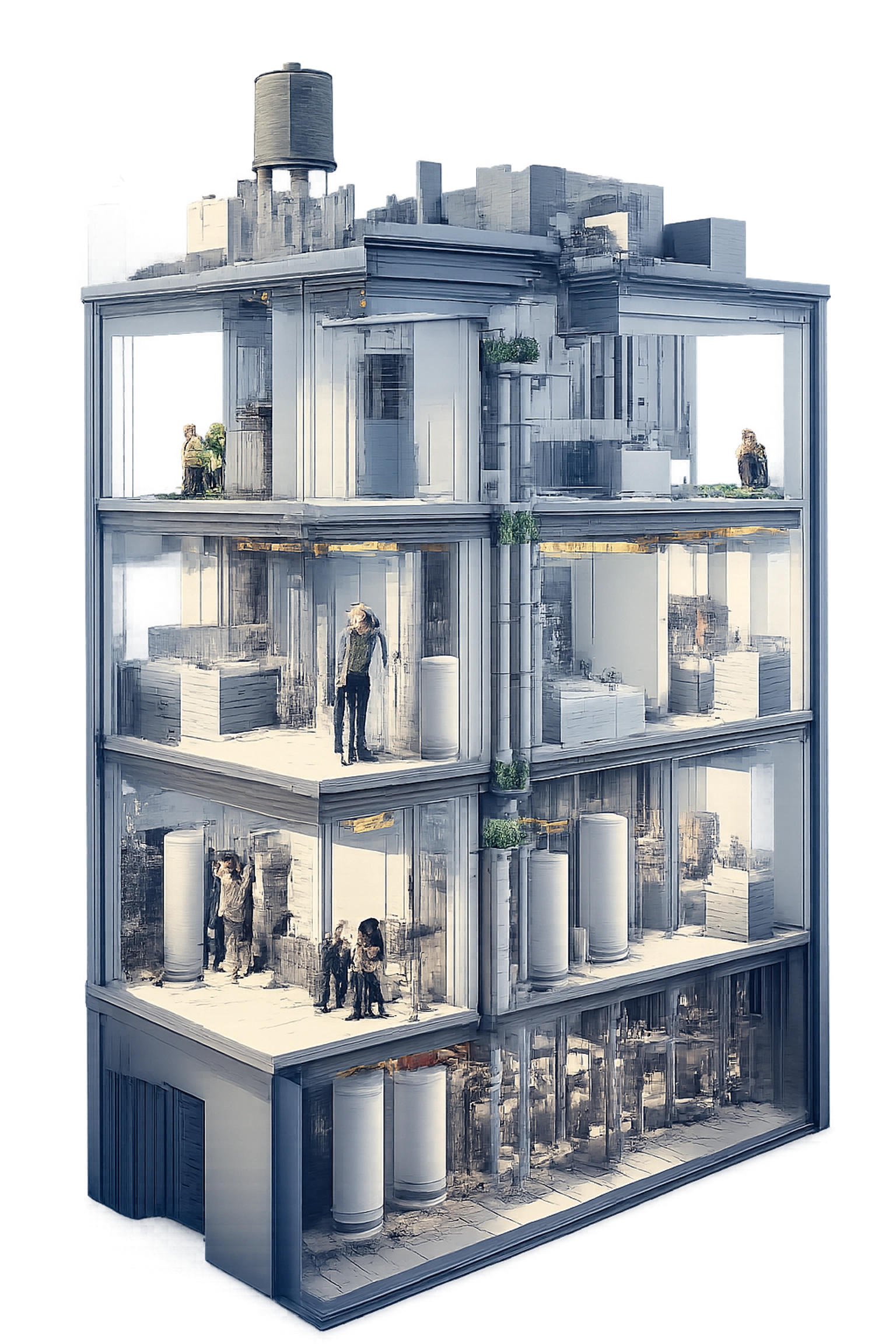
Multi-family properties are maintenance-intensive by nature. Shared systems: plumbing, electrical, roofing, and HVAC: serve multiple units, which means more wear and more potential points of failure.
In older Queens buildings (and there are plenty of them in Ridgewood, Astoria, and Flushing), you're often dealing with aging infrastructure that requires proactive attention rather than reactive fixes. Waiting until something breaks usually costs more in the long run.
Common maintenance responsibilities include:
Then there's the unpredictable side: the 11 PM call about a water leak, the Sunday morning heating failure in January, or the backed-up sewer line affecting half the building. These emergencies don't wait for business hours, and they require immediate action.
With multiple tenants under one roof, your role shifts from landlord to on-site manager: and sometimes mediator. Each tenant has their own communication style, expectations, and concerns. Multiply that by 6, 10, or 20 units, and you're spending a significant portion of your week just managing relationships.
Common tenant-related tasks include:
In neighborhoods like LIC and Astoria: where tenant turnover can be higher due to the younger, more transient renter demographic: you may find yourself cycling through this process more frequently than in other parts of Queens.
Queens is one of the most diverse boroughs in the country, and that diversity extends to its real estate landscape. Each neighborhood presents its own set of opportunities and challenges for multi-family owners.
Astoria – A mix of older rent-stabilized buildings and newer market-rate developments. High tenant demand, but also high expectations for responsiveness and building quality.
Long Island City (LIC) – Rapid development has transformed this area, attracting young professionals and families. Competition among landlords is stiff, and maintenance standards are high.
Flushing – A dense, commercial-heavy area with a significant number of multi-family properties. Language diversity among tenants can add communication complexity.
Ridgewood – Often grouped with Bushwick, this area has seen increased investor interest. Many buildings are older, requiring more hands-on maintenance attention.
Understanding the nuances of your specific neighborhood helps you anticipate challenges: but it also adds to the knowledge base you need to stay on top of.
For a broader comparison of what property management looks like across the borough, check out our post on Brooklyn vs. Queens property management costs and services.

At a certain point, the hours you spend self-managing have a real cost: even if it's not showing up as a line item on your expense sheet. Time spent chasing down late rent, coordinating repairs, or navigating DHCR filings is time you're not spending on your career, your family, or your next investment opportunity.
Outsourcing to a Queens property management company makes sense when:
A professional property management company handles the operational demands: tenant screening, rent collection, maintenance coordination, compliance filings: so you can focus on higher-level decisions like acquisitions, capital improvements, or long-term financial planning.
Not all property management companies offer the same level of service. When evaluating your options, look for a partner that aligns with your priorities as an owner.
Full transparency with no hidden fees – You should know exactly what you're paying for, with no surprise charges for routine services.
24/7 online portal access – Real-time visibility into documents, maintenance requests, and financials keeps you informed without constant phone calls.
Rent stabilization expertise – If your building includes stabilized units, your property manager should have deep knowledge of HPD and DHCR compliance requirements.
Combined buying power – A well-connected management company can leverage relationships with vendors and insurers to reduce your operating costs.
Licensed Realtors on staff – When it's time to fill vacancies or explore a sale, having licensed professionals in-house streamlines the process.
At Landlord Management (LLM), we provide Queens property management services built around these principles. Our team specializes in multi-family property management in Queens: including rent-stabilized buildings in Astoria, LIC, Flushing, Ridgewood, and beyond.
Self-managing your Queens multi-family property might have made sense when you first acquired it. But as your portfolio grows: or as your time becomes more valuable: outsourcing to a trusted property management company can free you from the daily grind while protecting your investment.
If you're curious what professional management could look like for your building, request a free proposal or reach out for a consultation. We'll walk through your current situation, answer your questions, and show you exactly how we can help.