

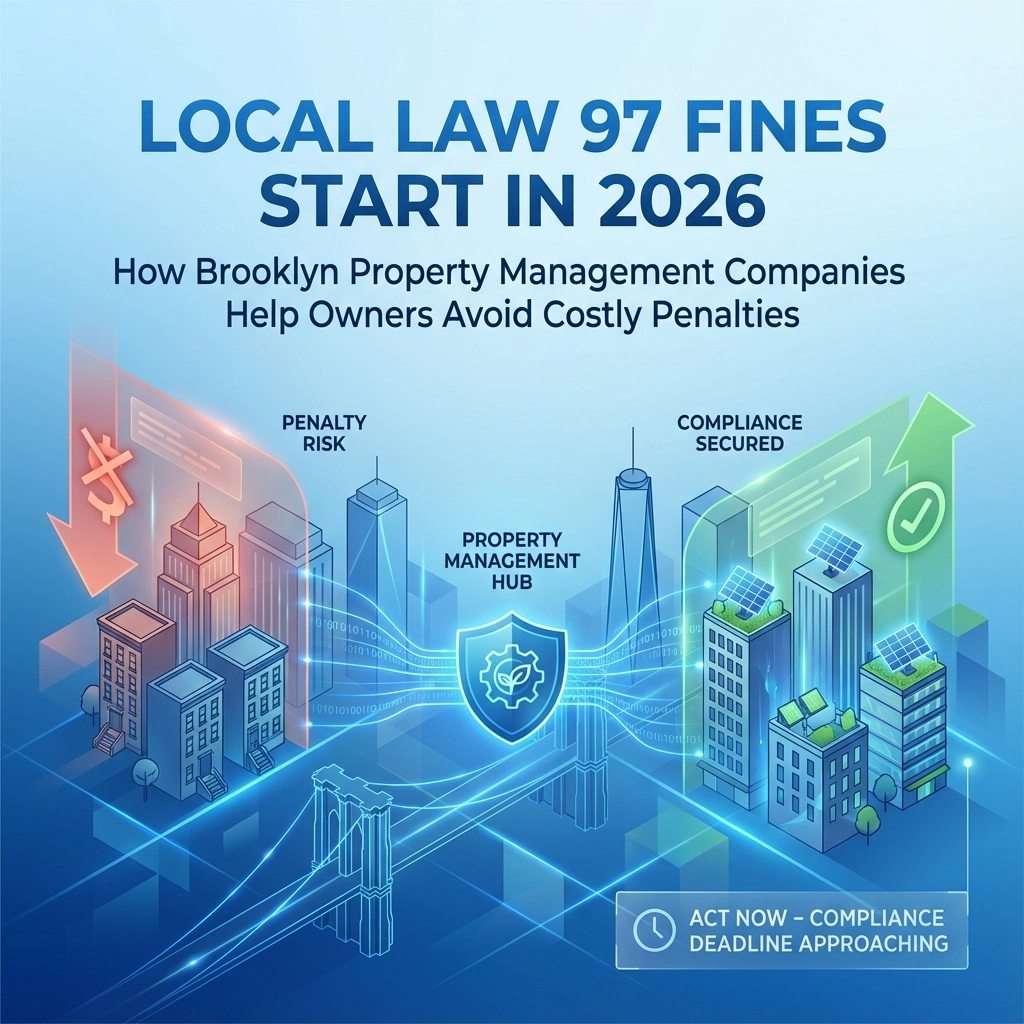
Property owners across Williamsburg, Bushwick, Bed-Stuy, Crown Heights, Park Slope, Flatbush, Sunset Park, Bay Ridge, Downtown Brooklyn, and Brooklyn Heights are now facing active financial penalties under New York City’s Local Law 97. As of 2026, the grace period has ended, and buildings exceeding their carbon emissions limits face substantial annual fines that can reach tens of thousands of dollars.
For Brooklyn’s multi-family buildings and condo/co-op boards, understanding compliance requirements and implementing strategic energy management has shifted from optional to financially critical. Property management companies in Brooklyn NY are increasingly becoming essential partners in navigating these complex regulations and avoiding costly penalties.
What is Local Law 97 and Why Should Brooklyn Property Owners Care?
Local Law 97, part of New York City’s Climate Mobilization Act, establishes mandatory carbon emissions limits for buildings over 25,000 square feet. The law targets approximately 50,000 buildings citywide, including many of Brooklyn’s larger apartment complexes, co-ops, and condominiums.
The legislation operates on a two-phase timeline. The current 2024-2029 compliance period serves as the initial benchmark, while the 2030-2034 period introduces significantly stricter limits: approximately 40% tighter than current requirements. Buildings must measure, report, and stay within their assigned emissions limits or face escalating financial consequences.
For Brooklyn property owners, this means every multi-family building, co-op, or condo over the size threshold must now actively monitor and manage their carbon footprint as a core business function, not just an environmental consideration.

What Changed in 2026: Active Penalties and Real Financial Impact
Starting in 2026, Local Law 97 penalties became active enforcement mechanisms rather than future threats. Buildings exceeding their carbon emissions limits now face $268 per metric ton of CO2 equivalent over their limit, assessed annually.
The financial impact scales quickly. A building exceeding its limit by 150 metric tons faces $40,200 in annual penalties. For a property 500 metric tons over its limit, the annual fine reaches $134,000. These penalties compound year after year until the building achieves compliance.
Additional penalties apply for administrative failures. Buildings that miss filing their annual emissions report face $0.50 per square foot per month. For a typical 100,000-square-foot Brooklyn apartment building, this translates to $50,000 monthly until the filing is complete. False statements on emissions reports carry penalties up to $500,000 per violation.
The stakes escalate dramatically in 2030. While preliminary analysis suggests only 11% of buildings exceed current 2024-2029 limits, 63% are projected to exceed the tighter 2030-2034 thresholds without significant energy efficiency improvements.
What are the Most Common Compliance Mistakes Brooklyn Property Owners Make?
Inadequate Baseline Measurement and Tracking
Many Brooklyn properties lack comprehensive energy monitoring systems, making it impossible to identify emission sources or track progress toward compliance. Without accurate measurement, owners cannot develop effective reduction strategies or verify compliance status.
Delayed Vendor Coordination and Project Planning
Energy efficiency retrofits, equipment upgrades, and system improvements require months or years of planning and execution. Properties that wait until compliance deadlines approach often face rushed installations, higher costs, and limited contractor availability.
Incomplete Record-Keeping and Documentation
Local Law 97 requires detailed annual reporting with verified emissions data. Buildings without proper documentation systems struggle to compile accurate reports and risk filing penalties or compliance disputes.
Underestimating 2030 Compliance Requirements
While many buildings currently meet 2024-2029 limits, the dramatically stricter 2030-2034 requirements catch unprepared owners with insufficient time and resources for necessary improvements.

How Can Brooklyn Property Owners Take Practical Steps Toward Compliance?
Conduct Comprehensive Energy Audits and Benchmarking
Professional energy audits identify specific opportunities for emissions reduction, from HVAC system upgrades to building envelope improvements. Benchmarking against similar Brooklyn properties helps owners understand their competitive position and realistic improvement targets.
Develop Multi-Year Retrofit Planning
Given the time required for major building improvements, successful compliance requires strategic planning spanning multiple years. This includes prioritizing highest-impact upgrades, coordinating with capital improvement schedules, and securing financing for energy efficiency projects.
Establish Vendor Networks for Energy Efficiency Work
Building relationships with qualified contractors, energy consultants, and equipment suppliers before urgent needs arise ensures better pricing, scheduling, and project quality. Bulk purchasing through vendor networks can reduce costs for smaller buildings.
Implement Systematic Record-Keeping and Reporting Systems
Compliance requires ongoing documentation of energy consumption, equipment performance, and improvement projects. Digital tracking systems help buildings maintain accurate records and streamline annual reporting requirements.
How Do Property Management Companies in Brooklyn NY Help with Local Law 97 Compliance?
Brooklyn property management companies serve as coordination hubs for complex compliance activities that exceed the capacity of individual property owners or small co-op boards.
Vendor Coordination and Project Management
Professional property managers maintain networks of pre-qualified energy efficiency contractors, consultants, and suppliers. They coordinate multiple vendors, manage project timelines, and ensure work quality while owners focus on their primary responsibilities.
Budgeting and Financial Planning for Energy Projects
Management companies help properties develop realistic budgets for compliance-related improvements, often leveraging combined buying power across multiple properties to reduce costs. They can structure multi-year capital improvement plans that align with compliance deadlines and building financial capacity.
Reporting and Documentation Management
Brooklyn NY property management companies maintain the systematic record-keeping required for Local Law 97 compliance. They track energy consumption data, coordinate annual emissions reporting, and maintain documentation needed for regulatory compliance or potential audits.
Ongoing Monitoring and Strategic Planning
Professional managers provide continuous monitoring of building performance and compliance status, identifying potential issues before they become costly penalties. They help properties prepare for the stricter 2030-2034 requirements with adequate lead time for necessary improvements.

Why Choose Professional Management for Local Law 97 Compliance?
Management companies brooklyn ny offer specialized expertise that individual property owners or volunteer co-op boards typically cannot develop in-house. They understand the technical, regulatory, and financial aspects of compliance while maintaining relationships with qualified service providers.
Professional managers also provide economies of scale. By coordinating energy projects across multiple properties, they can negotiate better pricing for audits, equipment, and installation services. This combined buying power often offsets management fees through reduced compliance costs.
Additionally, management companies maintain current knowledge of evolving regulations, available incentives, and best practices across similar Brooklyn properties. This expertise helps buildings avoid compliance mistakes that lead to penalties or inefficient spending on ineffective solutions.
How Landlord Management (LLM) Supports Local Law 97 Compliance
Landlord Management (LLM) provides transparent, comprehensive support for Brooklyn properties navigating Local Law 97 requirements. Our approach combines project management expertise with vendor coordination and financial planning specifically designed for multi-family buildings and co-ops.
Transparent Coordination at No Extra Charge
Unlike some Brooklyn property management companies that add surcharges for compliance coordination, LLM includes Local Law 97 support as part of our standard service. Owners access our vendor networks, project management, and reporting assistance without additional fees.
24/7 Portal Access for Real-Time Tracking
Our digital platform provides continuous access to energy consumption data, compliance status updates, and project progress. Property owners and board members can monitor their compliance position and improvement projects around the clock.
Simple Pricing with Combined Buying Power
LLM’s straightforward fee structure eliminates surprises while our combined buying power across multiple Brooklyn properties reduces costs for energy audits, equipment, and installation services. Properties benefit from bulk purchasing without complexity.
Comprehensive Project Management
From initial energy audits through retrofit completion and ongoing monitoring, LLM coordinates all aspects of compliance-related improvements. We manage contractor relationships, oversee project timelines, and ensure quality standards while keeping owners informed throughout the process.
Disclaimer: This information is for educational purposes only and does not constitute legal advice. Property owners should consult qualified legal and technical professionals for specific compliance guidance.
Taking Action on Local Law 97 Compliance
With penalties now active and stricter requirements approaching in 2030, Brooklyn property owners need immediate action plans for Local Law 97 compliance. Professional property management provides the expertise, vendor relationships, and project coordination necessary for cost-effective compliance.
Whether you own in Williamsburg, Park Slope, or any other Brooklyn neighborhood, the time for preparation has passed: compliance is now a present financial obligation requiring professional management and strategic planning.
Request a proposal and management quote at landlordmanagementny.com to learn how LLM can help your Brooklyn property achieve Local Law 97 compliance while minimizing costs and penalties.