

If you've ever watched your heating bill climb while tenants still complain about the cold, you know the frustration. NYC winters don't play around, and neither do HPD violations. The good news? You don't need to gut your building or drain your reserves to make a real difference.
Whether you own a brownstone in Brooklyn Heights or a multi-family in Astoria, these five budget-friendly insulation upgrades can help you keep tenants warm, stay compliant with NYC heat laws, and avoid those middle-of-the-night emergency calls about frozen pipes.
Let's break it down.
Why Does Building Insulation Matter for NYC Landlords?
Before we dive into the fixes, let's talk about why this matters beyond just comfort.
New York City has strict heat season requirements. From October 1st through May 31st, landlords must maintain indoor temperatures of at least 68°F during the day (when outdoor temps fall below 55°F) and 62°F at night. Fall short, and you're looking at HPD violations, potential fines, and some very unhappy tenants.
Poor insulation doesn't just make your building uncomfortable: it forces your heating system to work overtime. That means:
- Higher utility costs (whether you're paying or passing it through)
- More wear and tear on boilers and HVAC systems
- Increased risk of pipe bursts during cold snaps
- More tenant complaints and potential legal headaches
The reality is that many buildings in Brooklyn and Queens are older. Pre-war construction wasn't exactly designed with modern energy efficiency in mind. But that doesn't mean you need a massive renovation budget to make meaningful improvements.

What Are the Most Cost-Effective Insulation Upgrades?
Here's where it gets practical. These five upgrades won't break the bank, but they can make a noticeable difference in heat retention and tenant satisfaction.
1. Weatherstripping and Caulking: Sealing the Gaps Around Windows and Doors
This is the low-hanging fruit of winterizing rental properties: and honestly, it's where most buildings lose the most heat.
Those tiny gaps around window frames and door edges might not look like much, but they add up fast. In a typical NYC apartment, air leaks around windows and doors can account for 25-30% of heating energy loss. That's like leaving a window cracked open all winter.
What to do:
- Inspect all window and door frames for visible gaps or drafts
- Apply weatherstripping to movable components (the parts that open and close)
- Use caulk for stationary gaps and cracks around frames
- Pay special attention to older double-hung windows, which are notorious for air leaks
Cost estimate: $5-15 per window or door for materials. If you're hiring out, expect $50-100 per unit for a thorough job.
The ROI here is excellent. A proper seal job can reduce heating costs by 10-15% and dramatically cut down on tenant complaints about drafty apartments.
2. Thermal Curtains or Window Film: A Quick Fix for Drafty NYC Apartments
Sometimes the windows themselves are the problem. Single-pane windows (common in older Brooklyn and Queens buildings) are basically thermal sieves. Replacing them is expensive: we're talking $500-1,000+ per window installed.
But here's a workaround that costs a fraction of that.
Thermal curtains are heavy, insulated drapes that create an additional barrier between the cold glass and the living space. They're especially effective at night when temperatures drop and heat loss accelerates.
Window film is another option: a thin, transparent plastic layer that creates an insulating air pocket when applied with heat. It's not the most attractive solution, but it works surprisingly well.
What to consider:
- Thermal curtains work best in living rooms and bedrooms where tenants spend the most time
- Window film is a temporary solution (removed in spring) but can reduce heat loss through windows by up to 55%
- Both options are tenant-friendly and don't require any permanent modifications
Cost estimate: $20-50 per window for quality thermal curtains; $10-20 per window for film kits.
For property owners managing multiple units, buying in bulk can bring these costs down significantly. A good property management company in Brooklyn can help you source materials at better rates through vendor relationships.
3. Door Sweeps: Keeping Hallway Drafts Out of Units
Here's one that often gets overlooked: the gap under apartment doors.
In multi-family buildings, hallways can act like wind tunnels. Cold air enters through the building entrance, travels through common areas, and sneaks into units through the space under doors. Even well-heated apartments can feel drafty if that gap isn't addressed.
Door sweeps are simple devices that attach to the bottom of doors to block airflow. They're cheap, easy to install, and make an immediate difference.
What to do:
- Measure the gap under each unit door (they're often uneven in older buildings)
- Choose sweeps that match your door type (wood, metal, etc.)
- Install on both apartment entry doors and any doors leading to unheated spaces (basements, storage rooms)
Cost estimate: $10-25 per door for materials; installation takes about 15-20 minutes per door.
This is a perfect project for building supers or maintenance staff. For larger buildings, coordinating the work through an online portal keeps everything documented and on schedule.
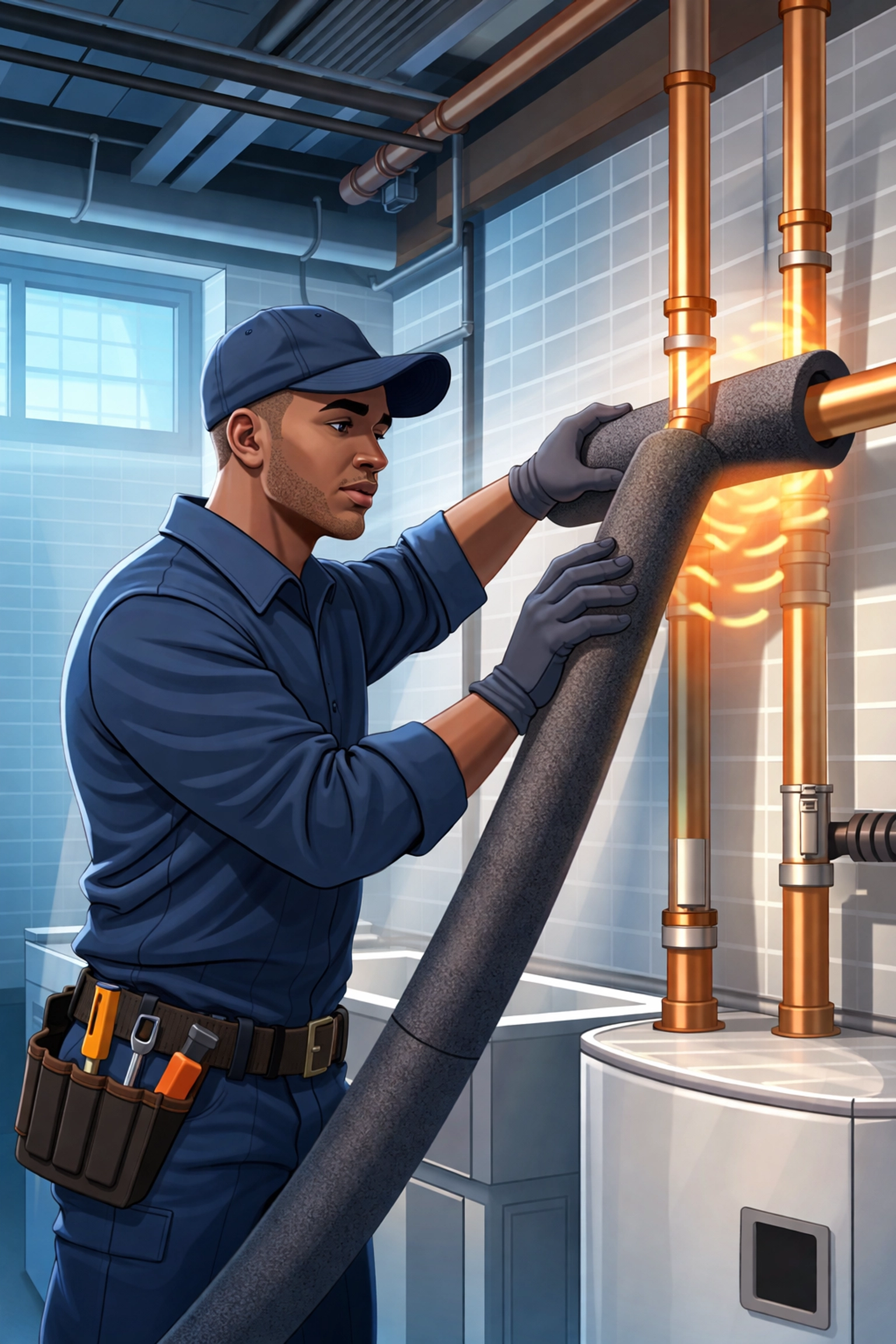
4. Insulating Pipes: Preventing Bursts and Saving Heat
Frozen pipes aren't just an inconvenience: they're a potential disaster. A single burst pipe can cause thousands of dollars in water damage, displace tenants, and create a compliance nightmare.
But even if your pipes don't burst, uninsulated pipes in cold spaces (basements, crawl spaces, exterior walls) lose heat constantly. That hot water traveling from your boiler to the radiators? It's cooling down before it even gets there.
Pipe insulation is one of the best returns on investment for any building.
What to do:
- Focus on pipes in unheated areas first (basement, garage, utility rooms)
- Use foam pipe sleeves for straight runs: they slip right on
- Apply heat tape or heating cables to pipes in particularly vulnerable spots
- Don't forget hot water supply lines: insulating these can reduce heat loss by 2-4°F
Cost estimate: $1-3 per linear foot for foam insulation; heat tape runs $10-20 per 6-foot section.
For a typical Brooklyn brownstone, you might spend $200-400 on materials to insulate exposed basement pipes. Compare that to the cost of a burst pipe repair (easily $2,000-5,000+), and the math speaks for itself.
5. Sealing Attic and Roof Hatches: Stopping Heat From Escaping the Top
Heat rises. That's basic physics. And in a building with a poorly sealed attic hatch or roof access point, a significant portion of your heating investment is literally floating away.
Attic hatches, roof access doors, and bulkhead entrances are often overlooked because they're out of sight. But these openings can be massive sources of heat loss: especially in buildings where the attic space isn't insulated.
What to do:
- Inspect all roof and attic access points for gaps and worn seals
- Apply weatherstripping around hatch frames
- Add rigid foam insulation to the back of hatch covers (the side facing the attic)
- Consider installing an insulated hatch cover if the existing one is thin or damaged
Cost estimate: $50-150 per access point for a thorough seal-and-insulate job.
This is one of those upgrades that pays dividends for years. A properly sealed attic hatch can reduce overall heating costs by 5-10%, depending on building size and configuration.
How Does Professional Property Management Help With Winterization?
Look, we get it: you didn't become a property owner to spend your weekends caulking windows and measuring door sweeps. That's where having the right support makes a difference.
At Landlord Management (LLM), we help Brooklyn and Queens property owners stay ahead of winter maintenance through:
- Budget analysis and vendor comparison to find the best deals on supplies and labor
- Coordination of repairs through our Secure Online Portal, so nothing falls through the cracks
- Licensed and insured contractors for all maintenance work: no cutting corners
- NYC heat compliance support to keep you on the right side of HPD regulations
Whether you're managing a single building or a portfolio across multiple neighborhoods, having a system in place for property management in Queens and Brooklyn means fewer emergencies and more predictable costs.
What's the Bottom Line on Budget-Friendly Insulation?
Winterizing rental properties doesn't have to be expensive or complicated. These five upgrades: weatherstripping, thermal curtains or film, door sweeps, pipe insulation, and attic sealing: can be completed for a few hundred dollars per unit and deliver real savings on heating costs.
More importantly, they help you avoid the headaches that come with NYC heat law violations and tenant complaints. In a market where good tenants are worth keeping, a warm, well-maintained building is a competitive advantage.
Ready to get your buildings prepped for the next big freeze? Reach out to our team to talk about how we can help coordinate your winterization projects( before the temperature drops.)