


If you own rent-stabilized apartments in New York City, the rent history on file with New York State Homes and Community Renewal (HCR) matters. Many people still call the agency DHCR. Your registrations form the official record of each unit’s rent over time. Errors can lead to overcharge claims, delays in a sale or refinance and confusion at lease renewal. Here is how owners pull a DHCR rent history, read it and correct mistakes the right way.
Key Takeaways
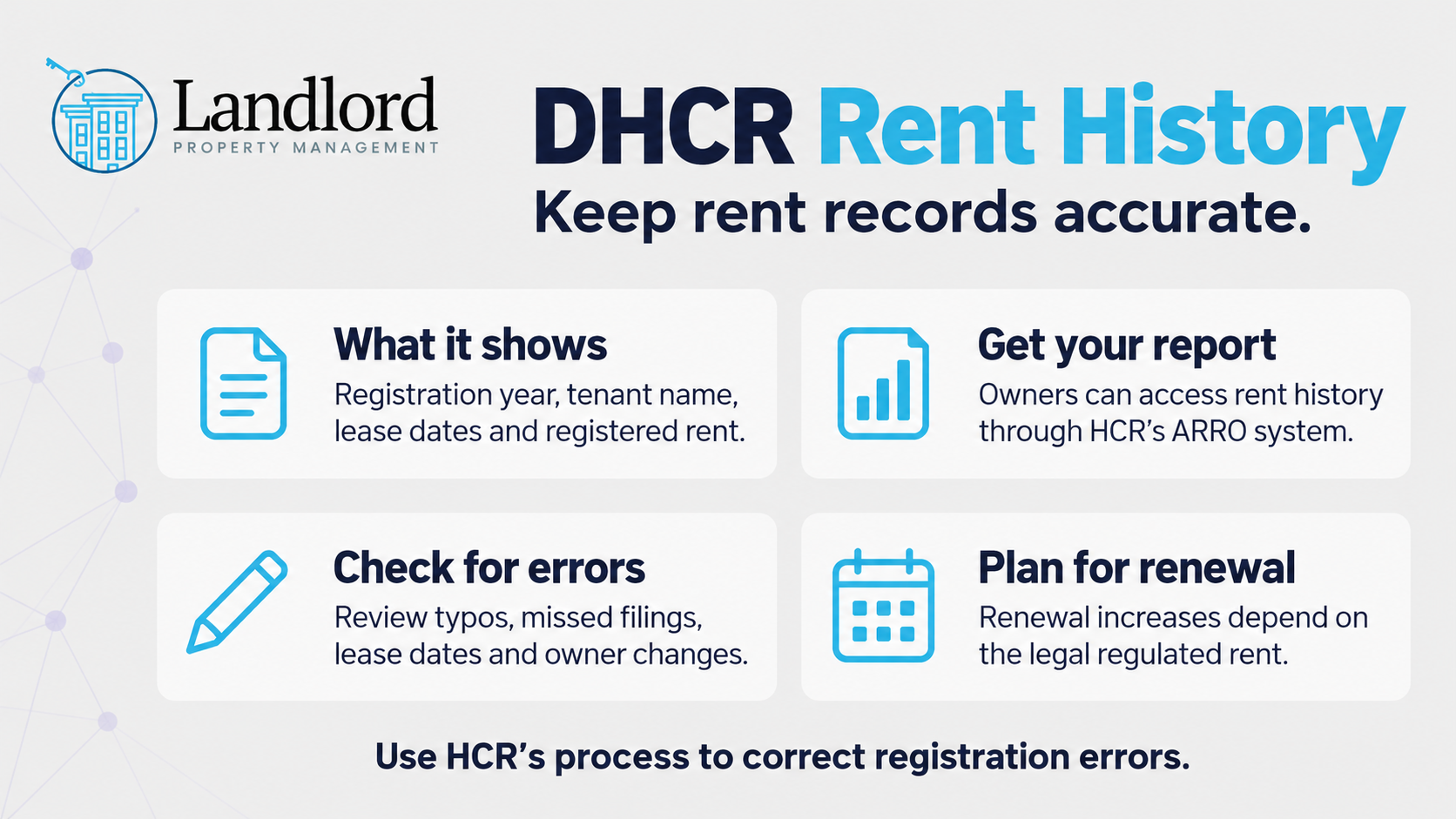
- A DHCR rent history shows each registration year, tenant name, lease dates and registered rent for a rent-stabilized unit.
- Owners can pull an ARRO rent history report through HCR, which is part of keeping rent stabilized apartment registration accurate.
- Errors come from typos, missed filings, wrong lease dates or ownership changes, and HCR describes the DHCR registration correction process.
- Accurate records matter at renewal, since increases are based on the legal regulated rent.
What Is a DHCR Rent History?
Each year, owners of rent-stabilized apartments register their units with the agency’s Office of Rent Administration. Each registration lists the tenant, lease information and rent. Over time, these filings build an apartment rent history. Under the law, the rent information is confidential. It can only be released to the unit’s tenant, the building owner or an authorized representative.
How Do Owners Pull a Rent History?
HCR’s Records Access page explains that owners can print certified Registered Apartment Information reports on their own. These reports are printed through ARRO, the agency’s online rent registration system. HCR offers print options covering 7 years or all years. HCR states that staff will not generate these reports at Borough Rent Offices or through its Records Access Unit.
Owners can also request other records, such as orders and case files, through the Office of Rent Administration. Requests can be emailed or mailed with form REC-1. Owners must attach proof of ownership, such as a deed, tax bill or proof of an active ARRO account.
How Do You Read the Report?
The report lists each registration year with the tenant name, lease dates and registered rent. Go through it with your leases open next to you. Look for missing years first. Then look for a rent that jumps or drops for no clear reason. A tenant name you don’t know is a flag. So are lease dates that overlap or leave a gap. In buildings that changed hands, the years right around the sale are where we tend to find the trouble.
An “-A” next to a registration year means the apartment was amended for that year, according to HCR’s registration FAQs.
What Causes Rent History Errors?
Errors can come from typos, missed filings, wrong lease dates or changes in ownership. Sometimes a prior owner or manager filed incomplete records. Improvements to a unit may not have been documented properly. Whatever the cause, it pays to find problems early.
How Do You Correct the Current Year?
HCR’s registration FAQs describe the amendment process for annual registrations filed in ARRO. You print the building or apartment form that needs fixing from ARRO and write “AMENDMENT” across the top. The corrected information goes in by pen, marked with a highlighter so it stands out. If you’re amending an apartment, include a copy of the certified building summary form. The forms get mailed to the DHCR Rent Registration Unit, and the tenant gets a copy of the amendment. That last step is easy to forget and it matters.
HCR notes that amendments generally take several weeks to appear.
Can You Amend Prior Years?
This is where many owners get stuck. Under the Rent Code Amendments of 2014, owners who want to amend a registration for a year other than the current one must generally seek an order from DHCR by filing an Administrative Determination request. The exception is when the amendment was already directed by DHCR or another government agency, such as HPD or a court. In that case, you attach the directive.
An Administrative Determination request is a signed, notarized letter. It must state the reason for the amendment, the years involved and the information to change. It must include supporting evidence, such as the lease in effect on April 1 of that year.
So for a current-year mistake, an annual amendment through the Rent Registration Unit is usually the path. For an older year where HPD, DHCR or a court already ordered the change, you attach that directive. For an older year with no directive, you’ll generally need an Administrative Determination request, and that’s where gathering leases and proof first really pays off.
Why Does Accuracy Matter at Renewal?
Rent-stabilized lease renewals are based on the legal regulated rent. If the rent history is wrong, the renewal offer may be wrong too. That can lead to complaints, refunds or penalties. Read our rent stabilization overview.
A Yearly Habit Worth Keeping
Keep every lease and renewal, including the ones from tenants who moved out a decade ago. Register on time. Once a year, print the rent history and sit down with your leases for an afternoon, checking each unit’s names, dates and rents against the report. Mark what’s off. Current-year errors are worth fixing right away, while older ones usually need a lawyer’s eye before anything gets filed. If you’re buying a building, do this review before closing, not after.
When to Get Help
Some fixes are simple. Others are not. A unit with gaps over many years is hard. So is a building bought from an owner who kept poor records. If a tenant has already filed an overcharge complaint, call a lawyer before you file anything. A manager who knows DHCR rules can help organize the paperwork, but legal questions belong with counsel.
Common Mistakes to Avoid
The most common one is letting small errors sit until a tenant complains, at which point they’re no longer small. Filing a prior-year amendment without the right approval is another, and so is forgetting the tenant’s copy. And older leases get lost all the time, usually in a move between managers.

Get Help With Rent-Stabilized Compliance
A clean DHCR rent history protects your building’s value. Landlord Management helps owners across Brooklyn, Queens, Manhattan and the Bronx with rent registrations, renewals and compliance. Want reports you can actually use? Call Landlord Management at (718) 536-2642 or request a proposal.
This article is general information, not legal, tax or accounting advice. Laws and agency rules change, so confirm current requirements with a qualified professional or the agency involved.
Frequently Asked Questions
Q: How do owners get a DHCR rent history?
A: Owners can print certified Registered Apartment Information reports through ARRO.
Q: Who can see an apartment’s rent history?
A: The tenant, the owner or an authorized representative.
Q: Can I fix a mistake in this year’s registration?
A: Yes. File an amendment with the Rent Registration Unit and give the tenant a copy.
Q: Can I amend a prior year?
A: Generally only with a government directive or an Administrative Determination from DHCR.
Q: What does “-A” mean on a rent history?
A: It means the registration for that year was amended.