


Some owners in Queens and Brooklyn get a one-page monthly report with three numbers on it: rent collected, expenses and what was wired to them. If your report looks like that, you may wonder if that’s normal. In our view, it shouldn’t be. Good property management reporting tells you where the money went and who is behind on rent. It also shows what got fixed and what’s coming up. Three numbers can’t cover all that. Below is what we’d expect each month.
Key Takeaways
- Good property management reporting gives NYC owners a clear monthly view of their building’s money and operations.
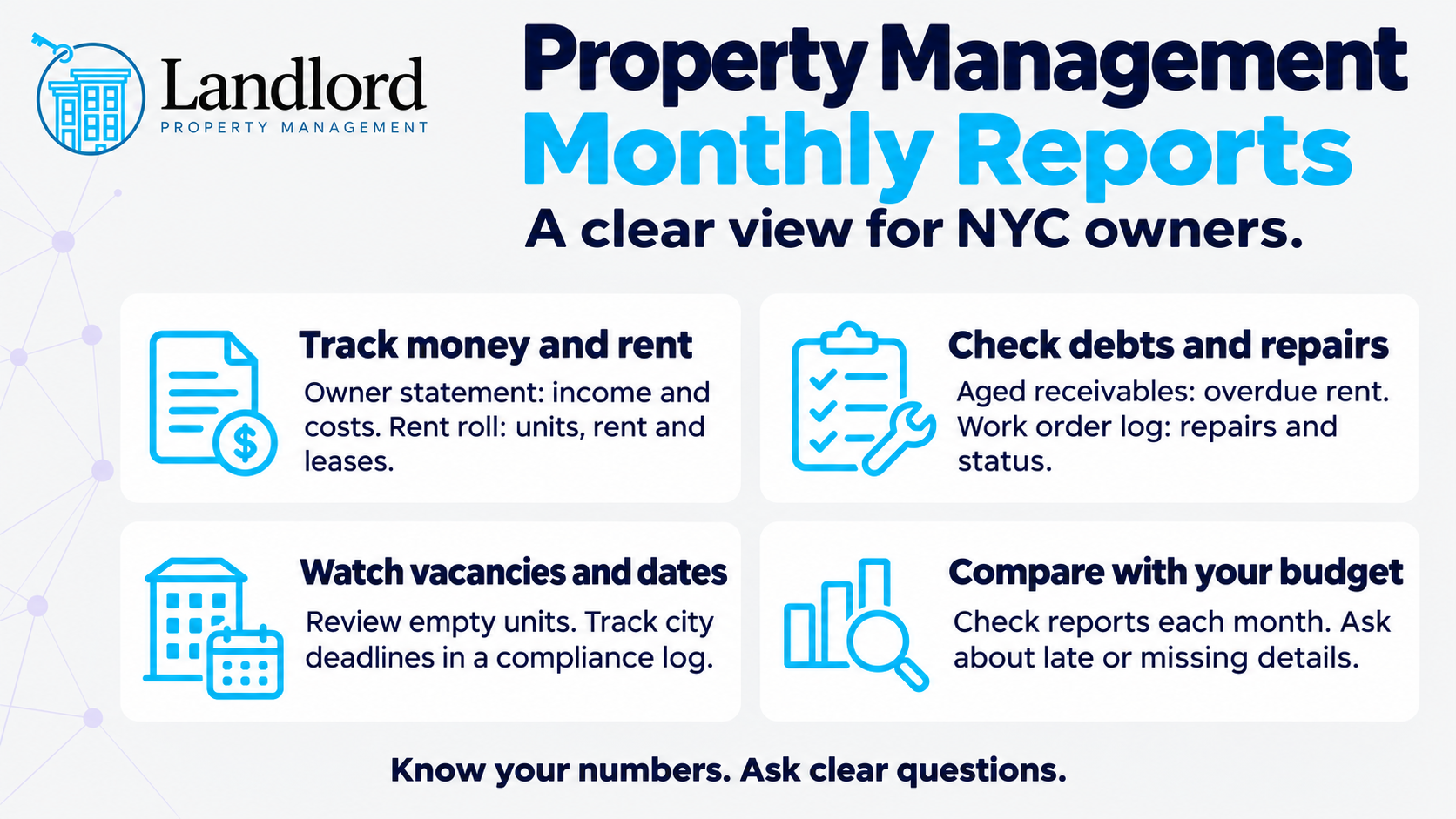
- The core property manager reports are the owner statement, rent roll, aged receivables report and work order log.
- Vacancy updates and a compliance tracker keep you ahead of city deadlines.
- Check each monthly report against your budget. Speak up when statements come late or leave things out.
The Statement Itself
The owner statement is the main part of the report. It should open with the cash balance at the start of the month and close with the balance at the end. In between, look for rent and other income, each expense by category, the management fee, any reserve held back and the amount sent to you.
Expenses deserve the closest look. An owner should be able to ask for the invoice behind any line and get it. A report that lists “Repairs” as one number could mean one plumber visit or five, and there’s no way to tell.
Who Lives There and What They Pay
A rent roll lists every unit, the tenant, the lease dates and the monthly rent. If any units are rent-stabilized, the rent on that roll should match the legal regulated rent registered with DHCR. When those two don’t match, you want to find out from your own report, not from a tenant’s lawyer.
The rent roll also shows which leases end in the next 90 days or so, which gives everyone time to plan renewals or turnover instead of being caught off guard by an empty apartment.
Who’s Behind
An aged receivables report shows which tenants owe money and for how long, usually grouped at 30, 60 and 90 days or more. Honestly, if we could only pick one report besides the statement, it’d be this one. A tenant who’s 30 days behind is a conversation. One who’s 120 days behind is usually a housing court case. Watching it monthly shows you how seriously your manager takes collections.
Repairs
In the work order log, you’ll find every repair request, the day it arrived, who took care of it and whether it’s done. You can see from it how quickly the manager responds. Patterns show up there too. Three low water pressure calls from 3R in six months could mean the riser needs a proper fix, not another patch.
Empty Units
If anything is vacant, you should hear how it’s being marketed, how many people saw it and what applications came in. Ten showings and no applications usually says something about the asking rent or the condition of the unit. No showings at all says something about the marketing.
Violations and Deadlines
NYC buildings always have another deadline coming. A short compliance section should cover open HPD or DOB violations, upcoming filings and recent inspections. We include it every month, even when nothing has changed. Skipping it is how things get missed. For more, see our post on HPD violations in NYC.
Year end
Each year, a property management report should get a full income and expense summary. Vendors you paid may also need tax forms. Find out from your manager when to expect them. Your accountant will need them well before the filing deadline, and tracking them down in late March is a hassle.
Comparing to the Budget
A good manager sets a yearly budget with you and checks each month’s real numbers against it. Nobody expects the budget to be exact. What matters is a clear reason when the numbers are off. Repairs might jump in February because a pipe burst. Income might drop because a unit sat empty or a tenant paid late. That’s fine, as long as you hear about it before you have to ask.
Portals
Plenty of property management reports use an online owner portal now. You log in and pull up statements, invoices and work orders at midnight if you want. Fine. We’d still ask how far back the records go, because a portal that only shows the last three months doesn’t help much when you’re refinancing.
Signs the Reporting Isn’t Good Enough
A report that shows up late is the first warning. Others are expenses without invoices and large “miscellaneous” lines. Watch for a rent roll that doesn’t match the income on the statement, and work orders left open for months. Even one of these deserves a call. If you spot a few at once, the books behind the report probably need work.
Reading it Each Month
Owners don’t need to be accountants to read these. We’d suggest picking one day a month and giving it about 30 minutes. Check that the rent total makes sense for the number of occupied units, look at receivables to see who’s late, scan the work orders for anything open too long and glance at the compliance list. Send all the questions in one email, and keep every report in one folder.
If you can’t follow your reports, say so and ask for a simpler format. A good manager won’t be offended. If one is, that tells you something too.
There’s one simple test we’d suggest to any owner. Ask for three invoices from last month and see how long they take to arrive. A manager with clean books can usually send them the same day.

Conclusion
Strong property management reporting is how trust gets built between an owner and a manager. Landlord Management offers financial transparency, owner portal access and 24/7 support for buildings across Brooklyn, Queens, Manhattan and the Bronx. Want reports you can actually use? Call Landlord Management at (718) 536-2642 or request a proposal.
This article is general information, not legal, tax or accounting advice. Laws and agency rules change, so confirm current requirements with a qualified professional or the agency involved.
Frequently Asked Questions
Q: What reports should a property manager provide each month?
A: An owner statement, rent roll, aged receivables, work order log and updates on vacancies and compliance.
Q: What is a rent roll?
A: A list of every unit with the tenant, lease dates and rent.
Q: What is an aged receivables report?
A: A report showing which tenants owe money and how long it has been owed.
Q: Should I get year-end reports?
A: Yes. A yearly income and expense summary helps with taxes.
Q: What is an owner portal?
A: An online space where you can view statements, invoices and work orders.