

Local Law 31

Lead poisoning is a serious health risk, especially for young children. NYC Local Law 31, part of New York City’s lead paint safety regulations, requires building owners to inspect apartments and identify lead-based paint hazards. Many residential buildings constructed before 1960 used paint containing lead, which can become dangerous when it chips, cracks, or deteriorates.

Children can accidentally ingest lead dust or paint chips that settle on floors, windowsills, or other surfaces. Because of this risk, New York City requires landlords to monitor painted surfaces, repair hazards, and ensure apartments remain safe for residents. 
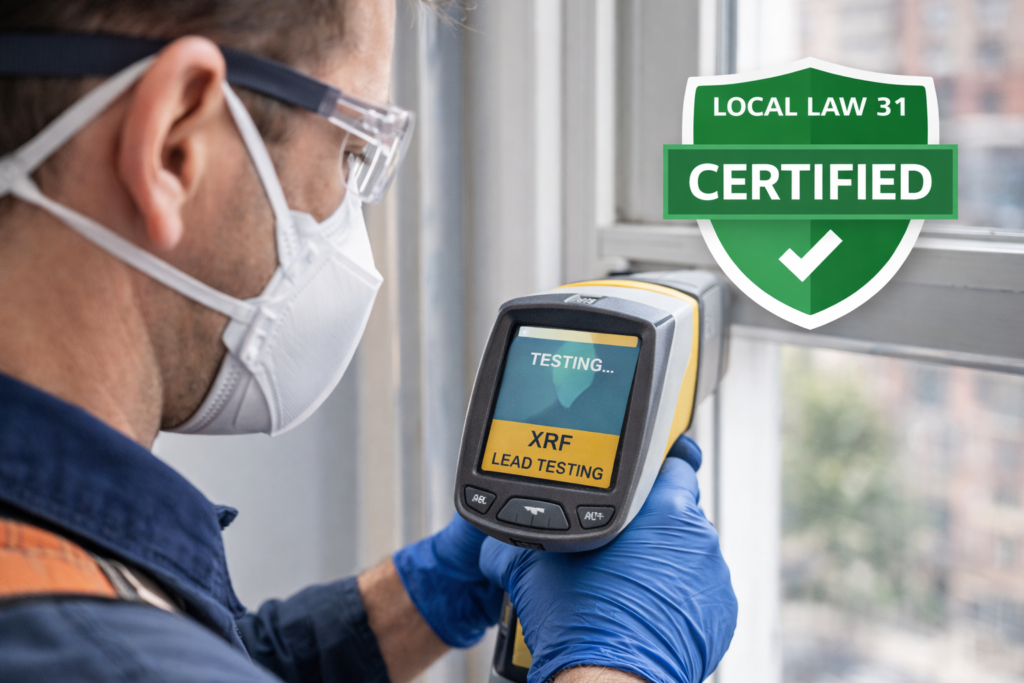
XRF testing device used for NYC Local Law 31 lead paint inspection

What Is NYC Local Law 31?

NYC Local Law 31 strengthens lead paint safety regulations by requiring property owners to identify and manage lead hazards in residential buildings. The law applies primarily to buildings built before 1960 where lead-based paint is most commonly found.

Lead Paint Responsibilities for NYC Landlords

If paint contains lead or has not been tested, property owners must take the following actions:

  • Monitor painted surfaces in apartments and common areas

  • Repair peeling or damaged paint

  • Provide an annual lead paint notice to tenants

  • Follow federal and city safety rules when performing repairs

  • Use certified contractors trained in lead-safe work practices

These requirements help prevent exposure to lead dust and paint chips, particularly for young children.

Lead Testing Requirements Under Local Law 31

Local Law 31 introduced additional inspection requirements to identify lead hazards in residential buildings.

The law requires:

  • XRF lead inspections for all dwelling units

  • Testing within five years of August 9, 2020

  • Inspections within one year if a child under six lives in the unit

These inspections must be performed by an EPA-certified inspector using approved testing procedures.

Contractor Requirements for Lead Paint Work

All home improvement contractors performing renovation work that may disturb lead paint must follow strict safety standards.

Contractors must:

  • Be EPA certified under the Renovation, Repair, and Painting (RRP) Program

  • Use lead-safe work practices

  • Provide proof of certification when applying for or renewing contractor licenses

These rules help prevent the spread of lead dust during construction or repair work.

Key Deadlines for NYC Building Owners

Building owners must complete lead testing requirements by August 2025.

However, if a child under the age of six moves into an apartment, landlords must arrange for an XRF inspection within one year.

Owners are also required to keep all lead inspection and repair records for at least ten years.

Why Lead Paint Regulations Matter

Lead exposure can cause serious health problems, particularly for children. Long-term exposure may result in learning disabilities, developmental delays, and behavioral issues.

By enforcing laws like Local Law 31, New York City aims to reduce lead poisoning and ensure residential buildings remain safe for families.

Building owners should also stay informed about other property regulations. Learn more about landlord responsibilities in our guide to NYC building compliance for landlords. 

Property owners can explore additional resources and services on the Landlord Management homepage 

According to the NYC Department of Housing Preservation and Development (HPD) , landlords must inspect apartments and correct lead paint hazards to protect children from exposure.